Affiliate Marketing for Beginners: What $11,768 From One Program Taught Me About Picking the Right Ones

Affiliate marketing is one of the few online businesses you can start with no product, no stock and no support team. You recommend something, a person buys it through your link, and the vendor pays you a share of the sale. US brands will spend about $13.81 billion on it in 2026, up 11.3 percent on the year before, according to eMarketer’s forecast.
The model has been around long enough to have a reputation, and the reputation is mixed. For every creator quietly earning a steady monthly figure from a handful of programs, there is a thumbnail promising $10,000 a month from a laptop on a beach.
If you have joined a few programs already, you have probably watched the clicks arrive and the commissions stay close to zero. But the affiliates in the top few percent pick different programs, judge them by different criteria, and share links with different people. None of that shows on a program’s signup page, which is why the first year goes badly for so many.
I have run affiliate income alongside my own products for years, and one program alone has paid me $11,768. This is the guide to affiliate marketing for beginners I wish I had read before joining my first dozen programs.
Affiliate disclosure: Some links on this page are affiliate links. If you buy through them, I may earn a commission at no extra cost to you. I will appreciate if you use them.
What affiliate marketing is
Affiliate marketing is the business of promoting someone else’s product and earning a commission when a person you refer buys it. From the vendor’s side, it is advertising they pay for only after the sale lands.
Three parties are involved. The customer wants a result. The vendor has a product that produces it. The affiliate stands between them and earns by matching the right person to the right product.
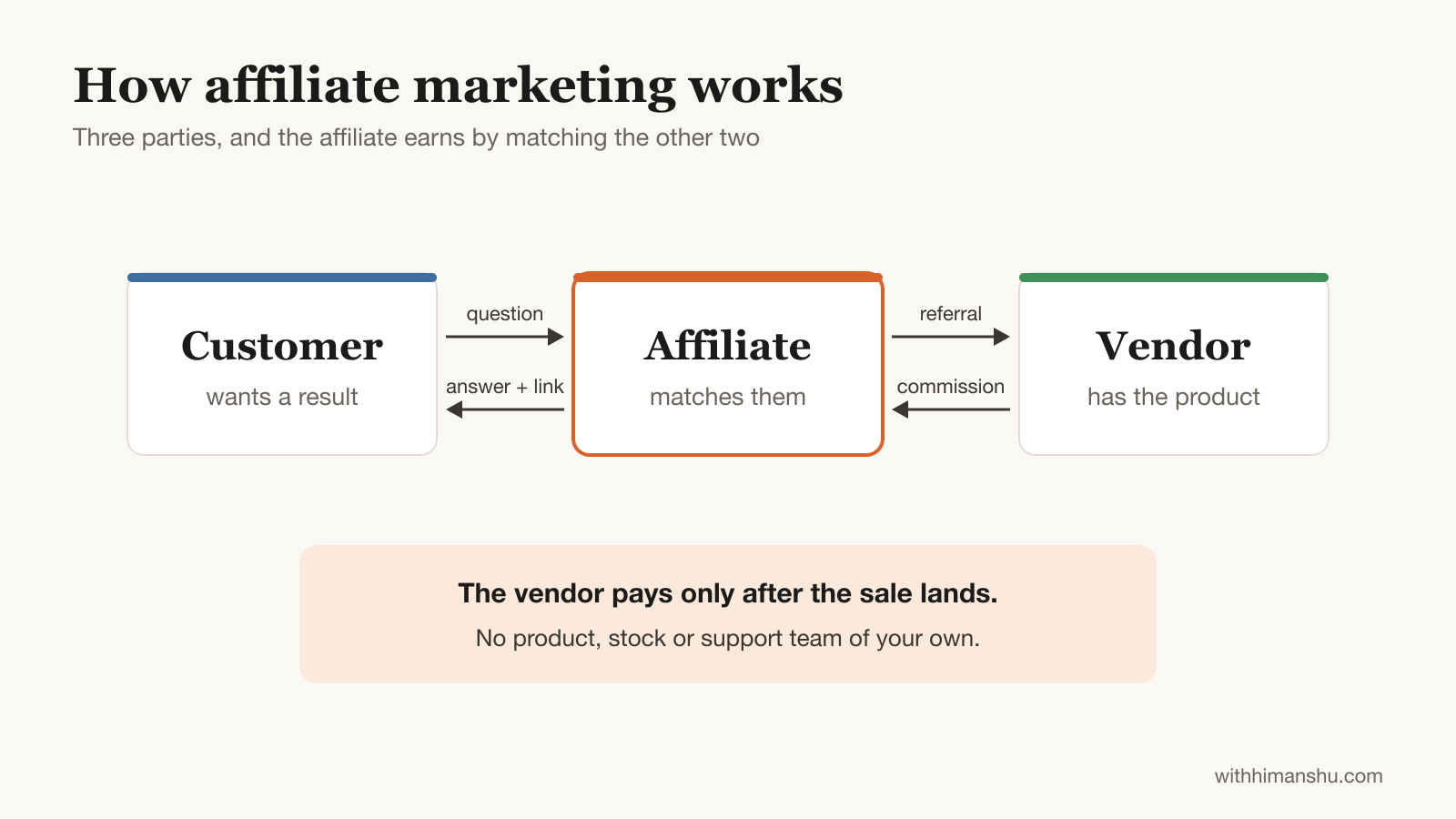
People do not buy a course, a tool or a supplement. They buy sleep, a working funnel, a finished website or a smaller waistline.
An affiliate who talks about the product sells at the low end of the conversion range. One who talks about the result, and has produced it themselves, sells at the top.
I have kept one rule from my early years, and it has outlasted every tactic:
Don’t sell pizza you have not tasted.
Every link on this site points at something I have paid for and used. The commissions follow from that, not from where the link sits on the page.
How much affiliate marketers actually make
Authority Hacker surveyed 2,270 affiliates and found an average of $8,038 a month. That number only means something next to the spread underneath it.
Affiliates with under a year of experience averaged $636 a month. Those with three or more years earned about 9.45 times more than beginners. Influencer Marketing Hub’s survey puts 57.55 percent of all affiliates under $10,000 a year, and only 3.78 percent above $150,000.
The income curve is steep and depends on time, so the first year works more like an apprenticeship than a verdict. The gap between the median and the top is also far wider than a better commission rate explains. Most of it comes from program selection and conversion, not effort.
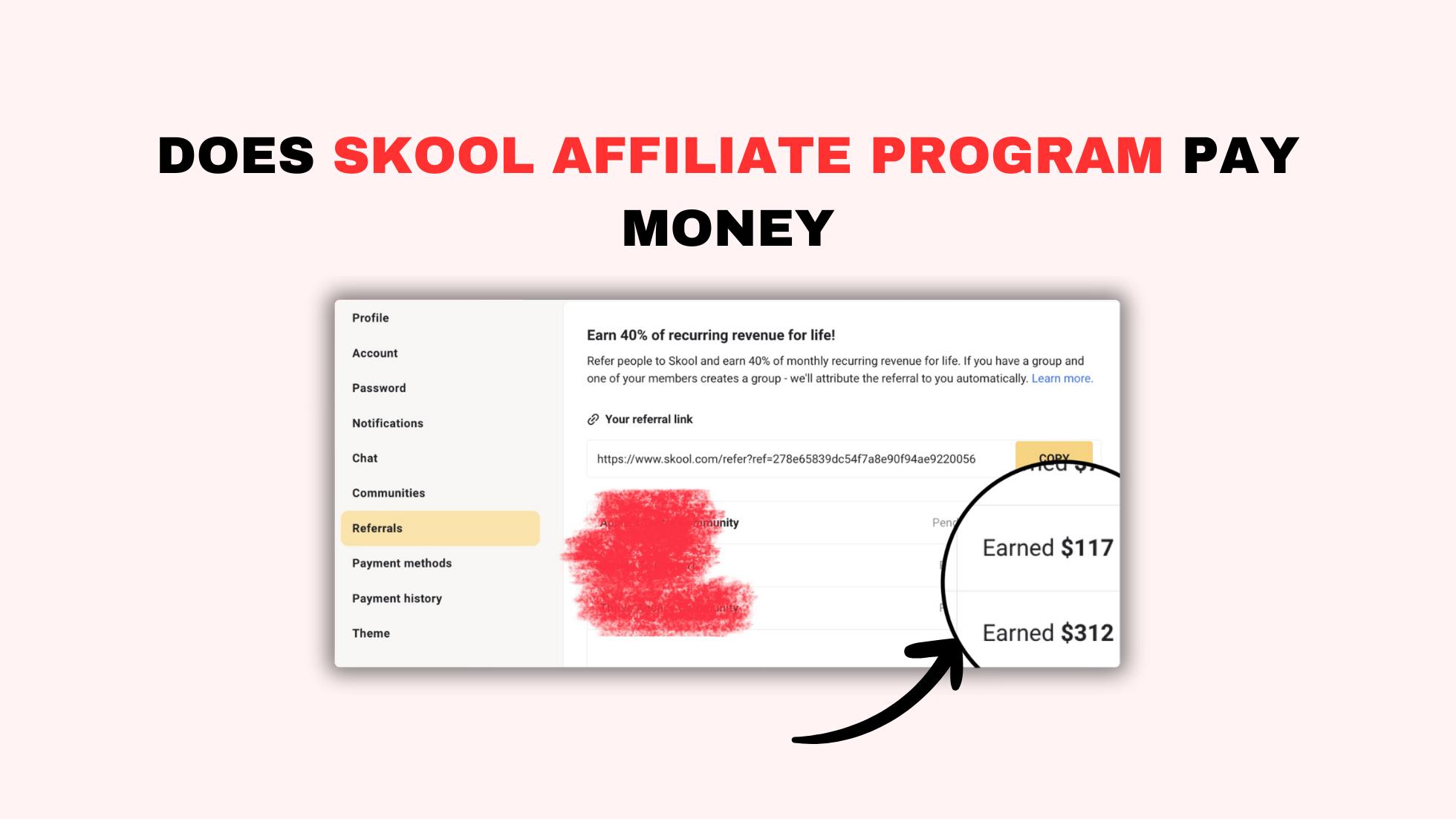
My own figure sits inside that pattern. The Skool affiliate program has paid me $11,768 from one product, recommended to people who were already asking which community platform to use.

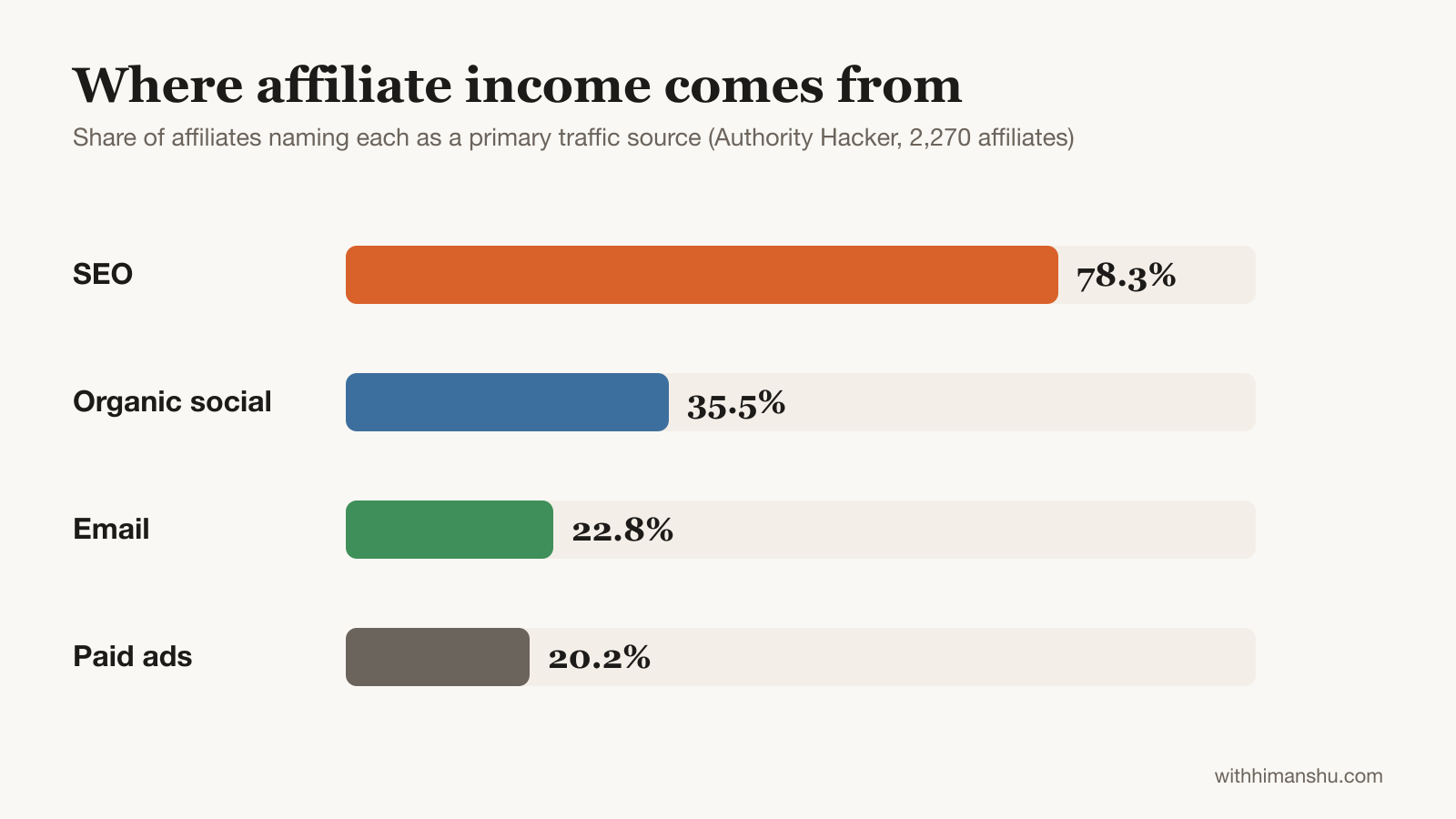
Search is still where most of that money starts. In the same survey, 78.3 percent of affiliates named SEO as a primary traffic source, ahead of organic social at 35.5 percent, email at 22.8 percent and paid ads at 20.2 percent.
The commission math that decides your income
Two numbers on a program page decide more than anything else you will do: the commission structure and the cookie window. Beginners tend to read the rate and skip both.
Amazon Associates pays between 1 and 10 percent in most categories, and everyday categories sit at 3 to 4 percent. The cookie lasts 24 hours. A reader who clicks today and buys on Thursday earns you nothing, unless they added the item to their cart inside the window.
A SaaS program typically pays 20 to 40 percent, and the better ones keep paying every month the customer stays. A 30-day cookie is the most common setting, and the median among SaaS programs is 60 days.
At the time of writing, Skool pays 40 percent of the plan price for as long as the group you referred stays open. Kit pays 50 percent of a customer’s payments for their first 12 months. Thrive Themes pays 35 percent on the first sale and 25 percent on renewals, and ClickFunnels pays 30 percent every month an account stays active.
One Amazon sale of a $99 product at 3 percent earns $2.97, once. One referral to Skool’s $99 Pro plan at 40 percent recurring earns $39.60 a month, and a customer who stays twelve months brings in $475.20.
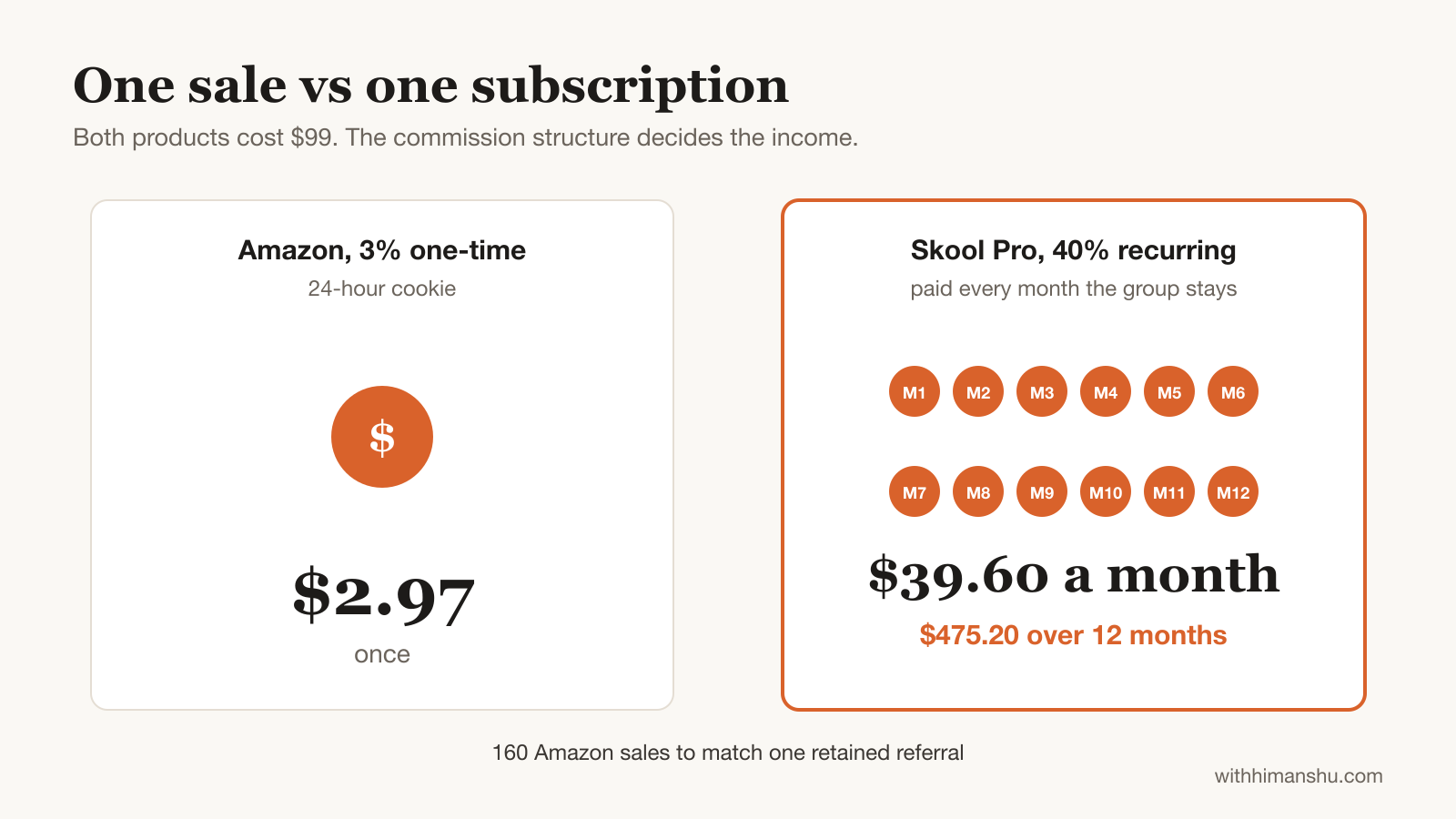
It takes 160 Amazon sales to match one retained subscription referral, and each of those Amazon buyers had to purchase inside a day. That gap is why a single recurring program has out-earned a dozen one-time programs for me by a wide margin.
Conversion rate is the variable you earn
Affiliate conversion averages 1 to 2 percent, meaning one or two buyers per hundred clicks. Top affiliates convert at 5 to 10 percent on the same products with the same links.
Nearly all of that difference comes down to who is clicking. A link in front of an audience, people who follow you but relate to you one-to-many, converts at the bottom of that range. A link in front of a community, people who know you and each other and who asked the question the product answers, converts at the top.
An audience gathers around you, while a community forms around its members. Inside a trusted room, a recommendation reads as advice rather than advertising.
That is also why about 1,000 core members can support a full-time creator business, while a much larger group of passive followers often cannot.
Many beginners join programs first and then look for people to send. The order that works for me runs the other way: build the audience, turn part of it into a community, and introduce products after that. I use the same audience, community and product sequence for every business I help build.
How to start affiliate marketing as a beginner, step by step
The steps below assume you have no audience yet. If you already have one, you can start at step two.
1. Pick a niche you can hold a conversation in
The topic comes before the product. A niche works when you are interested enough to publish about it for two years and can solve an actual problem inside it. A few dozen programs serving it is a reasonable floor.
Finding your niche is slower than picking a high-commission product, and it decides whether everything after it compounds.
2. Pick one product you have used
Just one: something you paid for, used for months and can describe the outcome of in a sentence. Your first piece of content about it should read like an answer to a friend who asked, which is the kind of content that converts at the top of the range.
3. Publish on something you own
A blog or an email list you build from scratch is yours. An Instagram account or a TikTok following is rented, and the landlord changes the rules.
Social platforms are fine for reach, and the email list is where that reach gets stored. In the survey data, SEO and email together outweigh social for affiliate income by a wide margin.
4. Set up the minimum tooling
You need a domain, hosting, an email tool and one way to build a landing page. I run my funnels through Thrive Themes and my email through Kit, and I have used both for years.
Black Friday is the cheapest week of the year to buy annual plans, as long as you only buy what you will use. The rest of the tools I use are listed in one place.
5. Disclose properly, in every post
Most beginner disclosures fall short of the FTC’s standard without the writer knowing. The next section covers placement and wording.
Start your email list with Kit
The programs worth a beginner’s time
The best beginner program is one whose product you already use, that pays recurring, holds a cookie of 30 days or more, and has paid affiliates for years.
Skool fits most of that filter for anyone building a community. Its cookie is 14 days, which matters less when people sign up in the same week they ask about platforms.
Thrive Themes and Kit suit anyone building funnels and an email list, since both pay on renewals. ClickFunnels is the choice for readers who would rather not run WordPress. The e-learning niche as a whole topped Authority Hacker’s income table at roughly $15,551 a month on average, which tracks with the recurring structures those programs use.
Amazon Associates is the usual first program, and the math argues against it. It is easy to join and converts well because buyers already trust Amazon. The 24-hour cookie and low rates put a hard ceiling on what a small audience can earn there. It works as a supplement in a product-review niche, not as the main program.
If you sell your own course or community later, the model flips and you become the vendor. Selling courses through affiliates uses everything in this guide from the other side, and the affiliates you want are the ones who understand it.
Disclosure, done the way the FTC wants
Affiliate commission is a material connection under the FTC’s Endorsement Guides, updated in 2023. It triggers the same disclosure as a paid sponsorship, even when you bought the product yourself.
The wording needs to say plainly that you earn money when readers buy. The FTC has said a bare “affiliate link” may not be understood by every reader, and its Disclosures 101 guide warns against vague labels such as “sp”, “spon” or “collab”.
Placement matters too. The disclosure belongs before the link and in the same view, not in a footer or on a separate page. It also belongs in every post that contains a link, since one disclosure per brand does not cover the next post.
The civil penalty now runs above $50,000 per violation and is adjusted for inflation each year. More practically, a clear disclosure raises trust. Readers who see that you earn from a recommendation, and that you say so plainly, treat the next one as more credible.
The disclosure on this page sits above the first partner link for the same reason.
The first ninety days
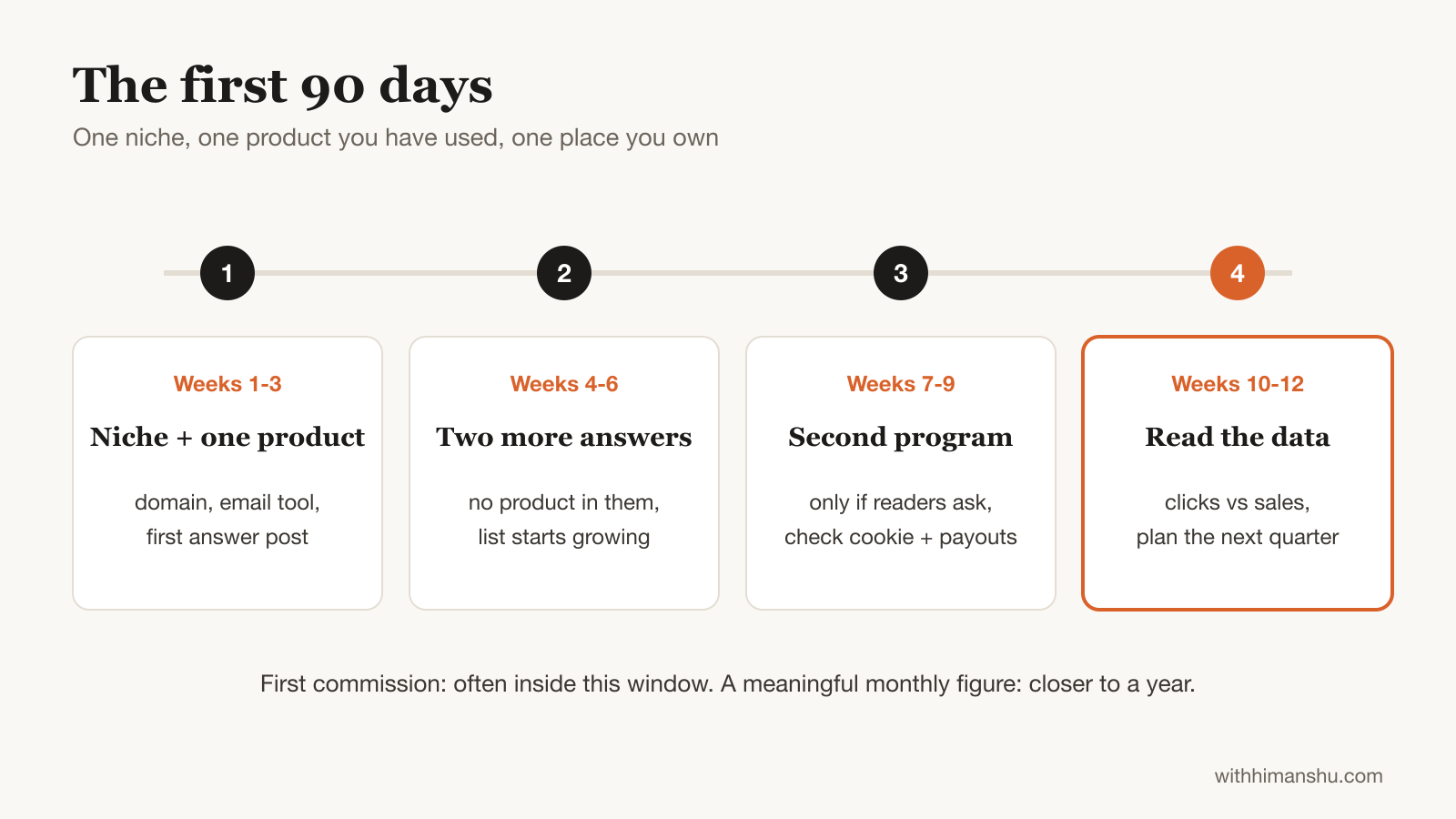
Weeks one to three. Pick the niche and the one product. Register the domain and set up the email tool. Write the first piece as the answer to the question that product solved for you, with the disclosure above the first link.
Weeks four to six. Publish two more pieces that answer nearby questions without a product in them. Start the email list from the first post. Reply to every comment and email, since the people who write back are the beginning of your community.
Weeks seven to nine. Join a second program only if a reader has asked about a problem it solves. Check the cookie window and the payout history before applying. Rewrite the first post with what you learned from readers’ questions.
Weeks ten to twelve. Compare which post produced clicks with which produced sales, because they are rarely the same post. The conversion data shows which question your readers are actually carrying, and the next quarter can be built around it.
The first commission usually arrives inside this window when the product is one you have used and the content answers a real question. The first meaningful monthly figure takes closer to a year, which matches the experience curve in the survey data.
FAQ
What is affiliate marketing?
Affiliate marketing is promoting another company’s product and earning a commission when someone buys through your tracking link. The vendor pays only after a sale or lead, so you need no product, inventory or customer support of your own. Commissions range from about 1 percent on Amazon to 40 percent recurring on some software programs.
How much do affiliate marketers make?
The largest recent survey found an average of $8,038 a month, but a small group of top earners pulls that figure up. Affiliates with under a year of experience averaged $636 a month, and 57.55 percent of all affiliates earn under $10,000 a year. Those with three or more years earned about 9.45 times more than beginners.
How do I start affiliate marketing as a beginner?
Start with a niche you can publish in for years and one product you have personally used. A blog or an email list gives you a platform you own. Programs that pay recurring commissions with a cookie of 30 days or more are the best first choice. The first meaningful monthly income usually takes close to a year.
Do I need a website for affiliate marketing?
You can start on social media, but a website or an email list is the asset you control. SEO was a primary traffic source for 78.3 percent of affiliates in the Authority Hacker survey, and a post keeps sending clicks for months after it goes live. Social reach depends on platform rules that change without notice.
What is a good affiliate commission rate?
The rate alone is misleading. A 40 percent recurring commission on a $99 subscription earns $475.20 over a year if the customer stays, while 3 percent on a $99 one-time purchase earns $2.97. Structure, cookie length and payment reliability tell you more about a program than the headline percentage.
How should I disclose affiliate links?
Affiliate commission is a material connection under the FTC Endorsement Guides, so every post with a link needs a clear disclosure. It belongs before the first link, in plain words that say you earn money when readers buy. The FTC has said a vague label on its own, such as affiliate link or collab, may not be clear enough.
Is affiliate marketing still worth it in 2026?
Yes, with the caveat that the income curve is steep and slow. US affiliate spend is forecast at $13.81 billion in 2026, up 11.3 percent on 2025. The affiliates capturing it pick recurring programs, promote products they use, and sell to people who already trust them.
The Letter
Get the next article in your inbox.
What I am building, as it happens. The experiments, launches and numbers behind my own one-person business, including what did not work.
The tools, tested before I recommend them. Short notes on the platforms I try for selling courses, running a community and sending email, before they become full reviews.
The inner side of the work. Ideas on focus, meaning and energy for solo founders who want a business that feels as good as it performs.
Get The Letter in your inbox
One short email, usually weekly. You can unsubscribe any time.
Keep reading
More from Guide.