DIY Link Building Is Sexy Again: Buying Backlinks vs Building Them in 2026

Links remain the clearest signal a search engine or an AI assistant has that someone else thinks your page is worth reading. A mention on the right page moves rankings. In 2026 it also decides whether ChatGPT or Perplexity names you when a buyer asks for a recommendation.
For most of the last decade the practical advice was to buy them. Agencies sold placements by the unit and marketplaces listed tens of thousands of sites with a price next to each. The whole model ran on the idea that enough links from enough domains would eventually lift a page, and plenty of people built real businesses on it.
If you have run a site for a few years, you have probably paid for at least one link. You waited for it to go live, checked the rankings for a month, and quietly wondered whether that $300 did anything at all.
But now the answer that decides your category is written by a model reading a handful of pages. Whether buying links still buys anything in that world, or whether the only links that count are the ones you earn yourself, is the open question.
I went through the 2026 pricing data, the outreach reply studies, the citation research on what AI answers actually read, and Google’s current policy to settle it.
Affiliate disclosure: Some links on this page are affiliate links. If you buy through them, I may earn a commission at no extra cost to you. I will appreciate if you use them.
What buying backlinks costs in 2026
The price of a paid link depends on which dataset you trust, and the spread tells you more than any single average.
Editorial.Link surveyed 518 SEO professionals and found the average price they would accept for one high-quality backlink is about $509. BuzzStream’s 2026 figures put a direct guest post at roughly $295 and the same placement bought through a vendor at $461. What they call a quality link sits closer to $1,500.
The marketplace data runs lower. Adsy’s February 2026 analysis of 52,671 sites found site owners list an average of $929 per backlink while buyers typically pay around $207. Saaslinks analysed 105,258 sites and put the median guest post at about $140, with 38 percent priced under $100 and 12 percent over $500.
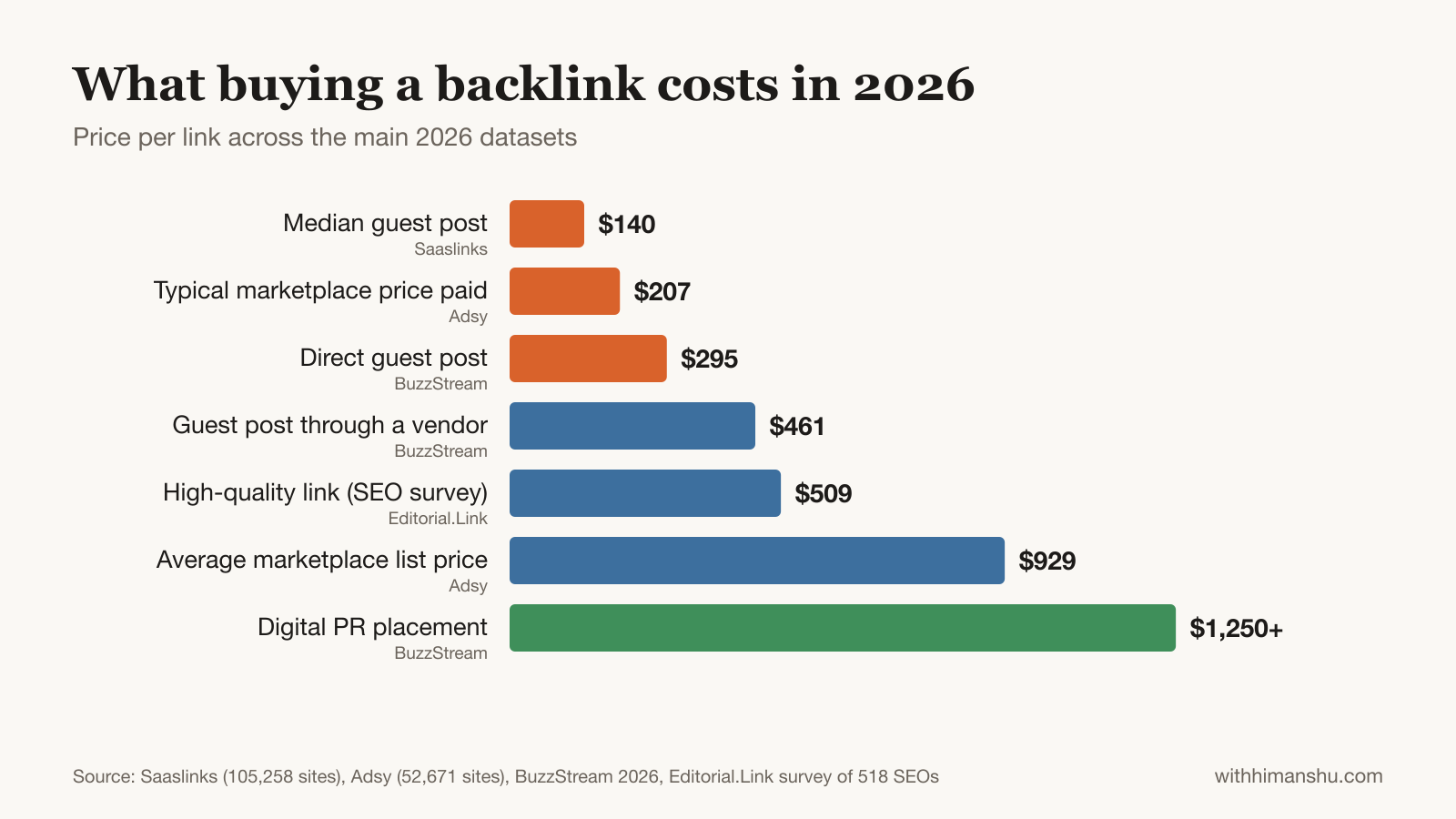
Digital PR sits in its own bracket at $1,250 to $1,500 per placement according to BuzzStream, and higher for national outlets.
A realistic paid budget, then:
A site buying four mid-tier links a month spends $15,000 to $20,000 a year on pages it does not control and cannot see the effect of.
Where the paid link money actually goes
A $140 guest post on a site that sells guest posts is a page whose only reason to exist is selling guest posts. The domain rating looks fine. The traffic is usually close to zero, and the other links on the page point at casinos, CBD, and whichever niche paid that week.
Google’s spam policies name “buying or selling links for ranking purposes” as link spam. The official position is that most of these links are ignored rather than punished. The money is spent, the link goes live, and the ranking system quietly declines to count it. A manual action is rare. The 2024 API documentation leak did reference a BadBackLinks signal, though, which suggests a heavily bought profile can carry a negative weight rather than a neutral one.
An Ahrefs survey cited across vendor blogs reports that 74.3 percent of link builders who had ever bought links did so in the previous twelve months. Buying has not gone away, though it has gone quieter, and the people still doing it tend to describe it as a numbers game.
The pages AI answers read mostly cannot be bought
AI assistants changed which links matter more than how many. When a buyer asks ChatGPT or Perplexity for the best tool in a category, the answer names two or three brands. It leans on a small set of pages to decide, and getting onto those pages is most of what generative engine optimization means.
A September 2026 analysis covered 3,118 answers to “who should I hire” style queries and 39,763 cited links. It found 50.2 percent went to company websites, 25.9 percent to directories and review sites, and 11.8 percent to “best X” listicles.
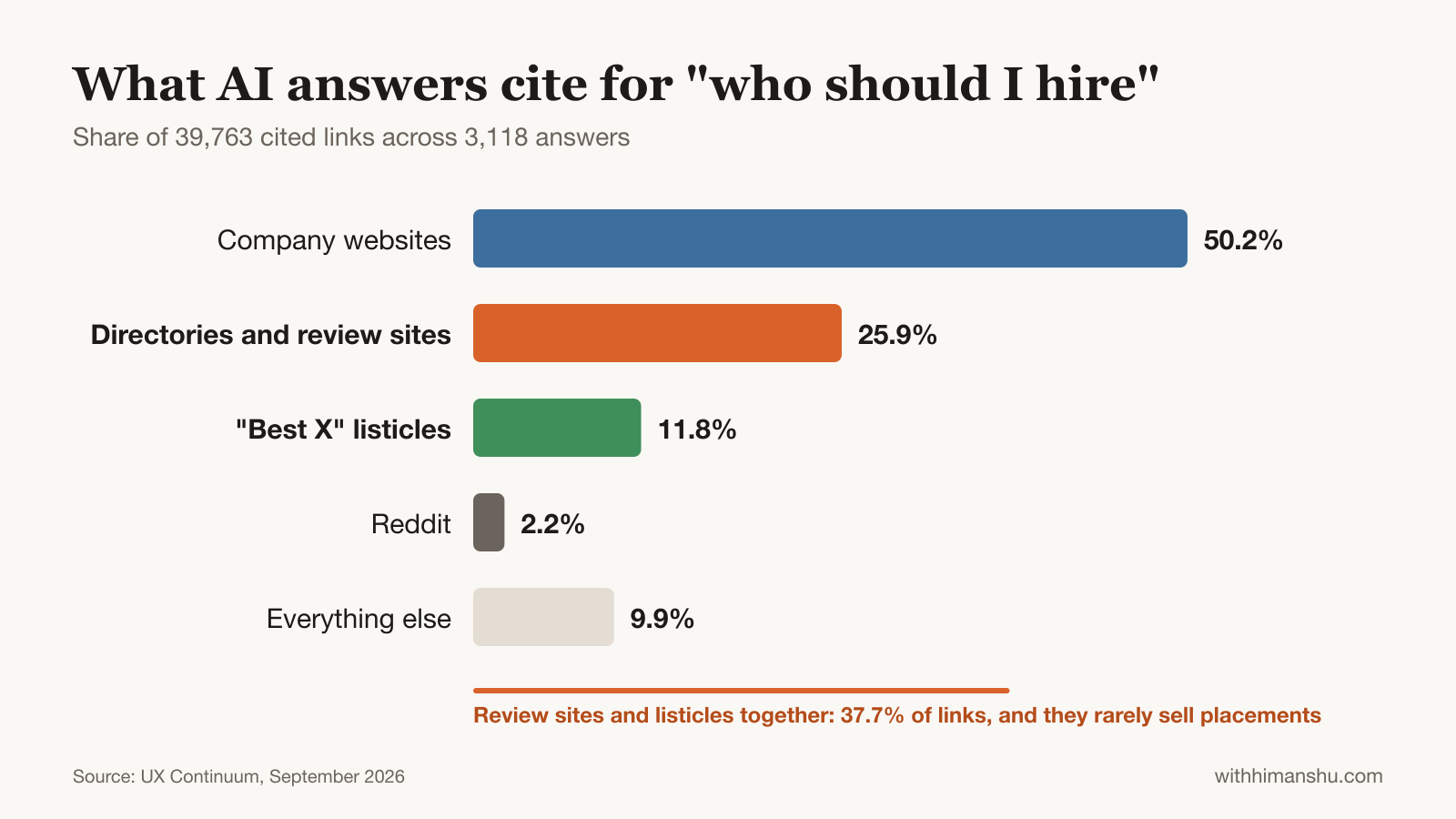
Directories and review sites appeared in 73 percent of Perplexity answers and 55.3 percent of ChatGPT answers. Reddit took 2.2 percent of links in that commercial set. Peec AI’s broader analysis of 30 million sources found Reddit is the single most-cited domain across engines, but that lead comes from general topics rather than buying questions.
Ahrefs’ data adds the piece that matters for budgets: 28.3 percent of ChatGPT’s most-cited pages have no Google organic visibility at all. The engines read the pages that answer the question, whether or not those pages rank.
Most of the pages behind those answers do not sell links at all. G2 and Capterra category pages do not sell placements, they sell profiles and reviews. Zapier’s best-of roundup has an editor, not a rate card. A Reddit thread about which CRM a founder picked cannot be bought at any price without getting the account banned. The listicle on a mid-tier publication might accept a sponsored mention, and then it carries the tag that tells the model it was paid for.
Why DIY link building is sexy again
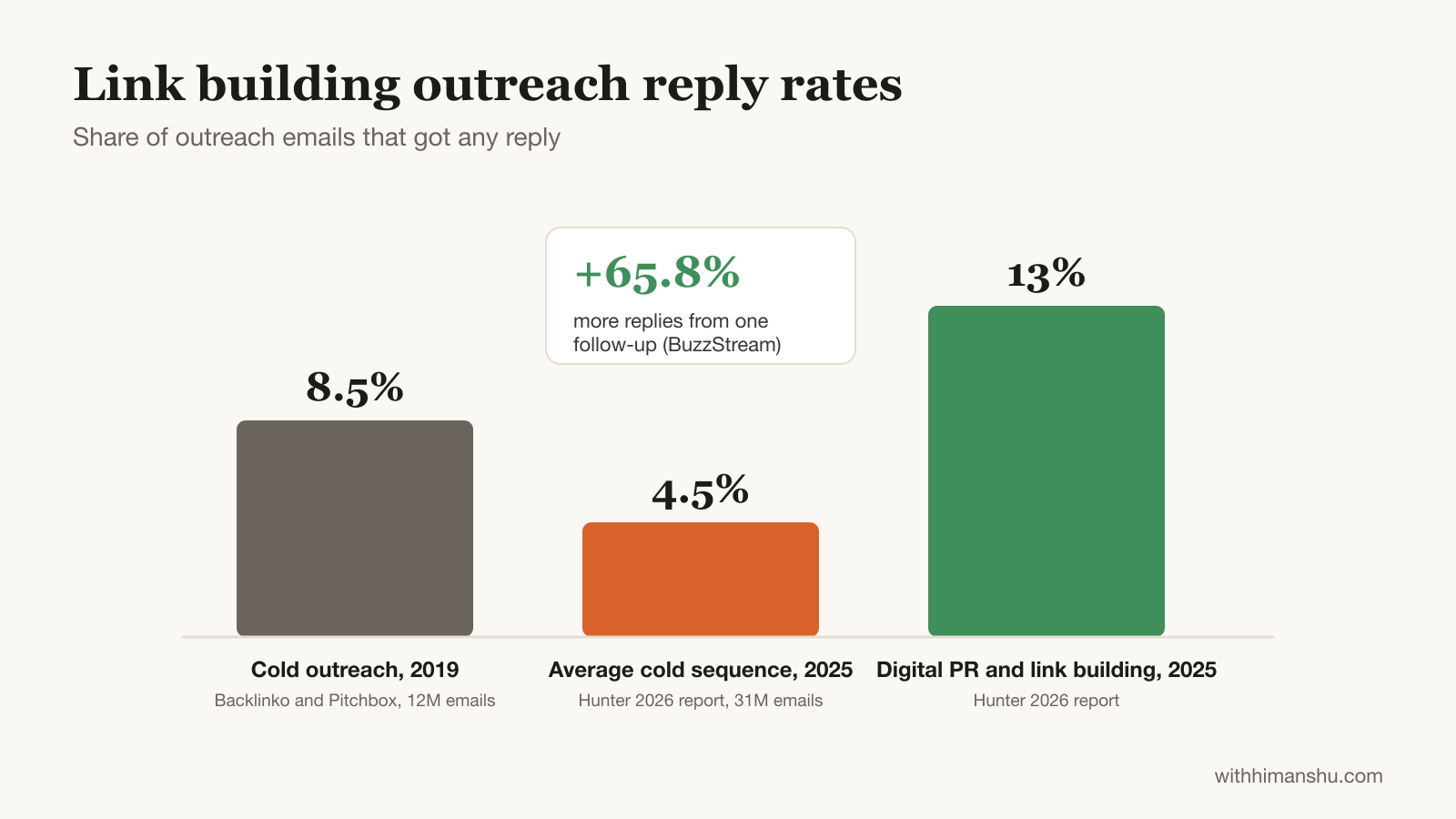
Five years ago the case against doing your own link building was labour. The target list was every domain in the niche above some DR threshold, the outreach was cold, and the reply rate was brutal. Backlinko and Pitchbox analysed 12 million outreach emails in 2019 and found 8.5 percent got any reply at all. Hunter’s 2026 report, built on 31 million emails sent in 2025, puts the average cold sequence at 4.5 percent. The digital PR and link building category comes in at about 13 percent.
Those numbers still hold for cold, generic outreach. A short list of named pages changes the maths.
The citation research turns an open-ended hunt into a short, named list. For any buyer question there are perhaps five to fifteen pages the answers lean on, and you can read them. Each one either lists you or it does not. The email to an editor whose roundup covers six tools and omits yours reads differently from a cold pitch about domain authority. It says their page answers “best CRM for startups”, that it currently covers Pipely and Closewise, and that a test account is available for the next update.
That email gets a different reply rate than “I noticed you write about SaaS.” BuzzStream’s data shows one follow-up lifts replies by 65.8 percent. Even so, 55.4 percent of digital PR professionals send only one. DIY wins on precision rather than volume: the right email to a list of ten outperforms a generic one to a list of five hundred.
The second thing that changed is that the work became a weekly habit rather than a campaign. A typical week means reading the ranked list of pages, sending three emails and checking what moved. LinkGecko, a DIY link building tool for online companies, runs that loop. It asks AI the questions buyers ask in your category, ranks the review sites, roundups and threads behind each answer, and drafts the editor email for each one. A weekly rerun shows which placements went live and which answers now name you. The plan is $29 a month with a seven-day trial. A directory package that never touches those pages runs $99 to $299, and an agency charges $300 to $500 per link.
What DIY link building looks like week to week
The practical version fits in an hour, and most of the hour is reading.
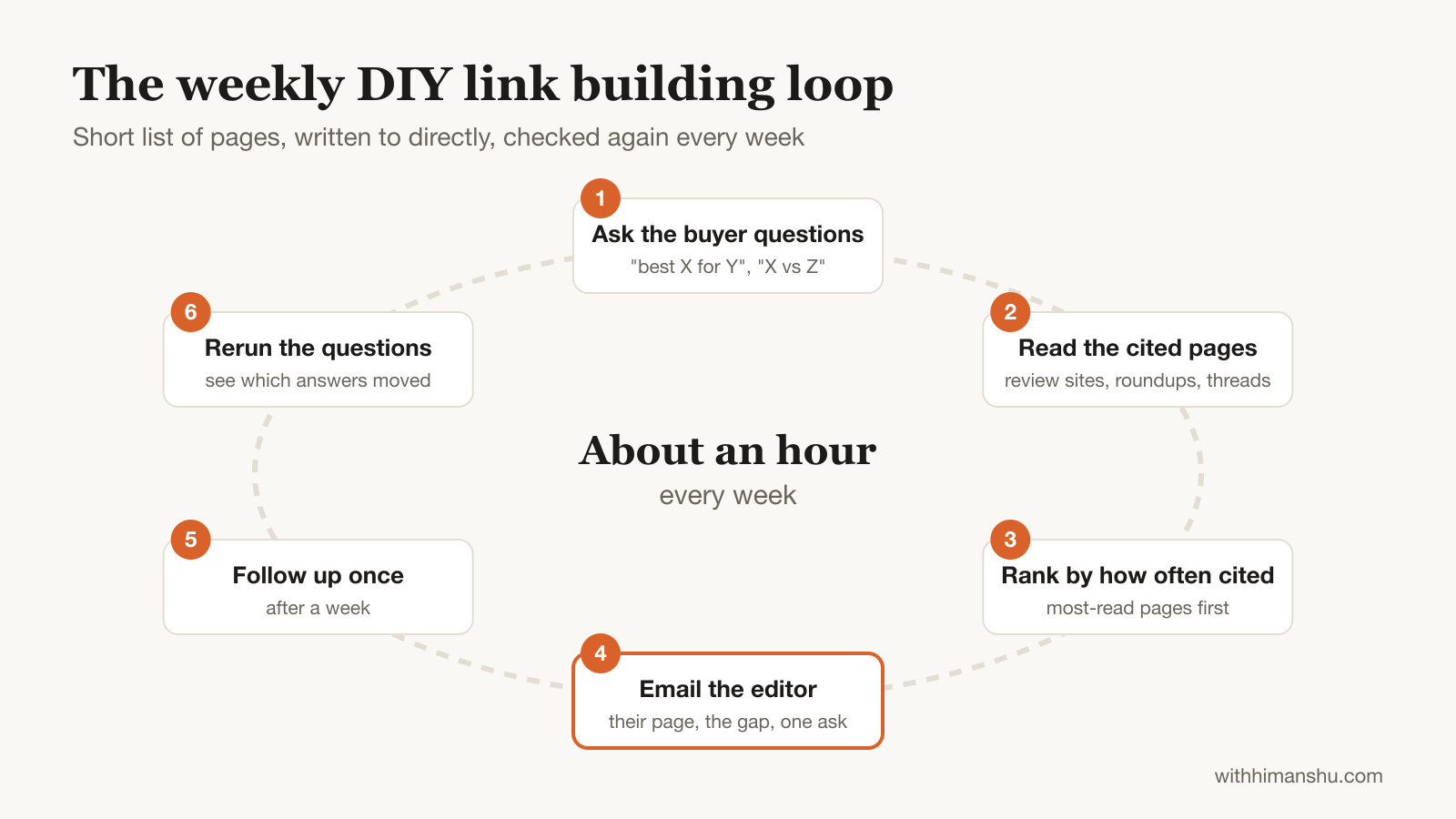
Start from the buyer questions, not from a domain list. “Best X for Y”, “X vs Z”, “is X worth it” are the shapes assistants get asked, and each one has a small set of pages behind it. A free run through the GPT SEO checker shows the answer for one question and the brands it names. That is enough to see whether you are in the running before you spend anything.
Sort the pages by how many answers read them. A G2 category page cited by nine answers is worth a complete profile and a review push before anything else. A Zapier roundup read by seven answers is worth one careful email. A Reddit thread read by five is worth one disclosed, useful reply from an account that has posted about other things.
Write to the editor about their page, not about your product. Name the question their list answers, the tools it covers, the gap, and the specific thing you can send them. Keep the ask to one line. Follow up once after a week, since the second email does most of the work and more than half of practitioners never send it.
Reread the answers a few weeks later. Some change within days of a page update and some take longer. The only way to know which placement paid off is to ask the same questions again and compare. That weekly rerun separates link building from link buying, because you can see what each placement did, question by question, instead of watching a DR number drift.
When buying still makes sense
Two cases survive the data.
Sponsored placements. A sponsored placement, marked as sponsored, on a site your buyers actually read is advertising with a link attached. If the page sends qualified traffic, the price is an ad buy and should be judged as one. It will not move rankings and it should not be expected to.
Digital PR. Digital PR at $1,250 and up is the other. Editorial.Link’s survey found 48.6 percent of SEOs rate digital PR the most effective tactic for 2026. The placements it produces sit on the national and trade pages that answers do cite. The constraint is budget. A team that can afford one placement a quarter gets more from a year of weekly outreach to the specific pages behind its category. PR can layer on top once that base is in place.
Everything in between, the $140 guest post, the vendor niche edit, the directory bundle, pays for a link the ranking system is designed to ignore, on a page the AI answer never reads.
FAQ
Is buying backlinks worth it in 2026?
Rarely for ranking. Google’s spam policies classify buying links for ranking purposes as link spam and the system is built to ignore them, while marked sponsored links pass no ranking value. Paid placements can be worth it as advertising when the host page sends real traffic, and digital PR at $1,250 or more per placement remains effective. Mid-tier guest posts at $140 to $500 mostly buy a link that is never counted.
How much does a backlink cost?
Across 2026 datasets, the median guest post is about $140 and the average paid price on marketplaces is around $207. Vendor-sourced guest posts average $461, SEOs put a high-quality link at roughly $509, and digital PR placements run $1,250 to $1,500. Listed prices average $929 per link, well above what buyers typically pay.
Does link building still matter for AI search?
Yes, with a change in which links count. AI answers lean on directories, review sites, best-of listicles and community threads to decide which brands to recommend. 28.3 percent of ChatGPT’s most-cited pages have no Google organic visibility. A mention on one of the pages an answer reads changes the recommendation. A link from a page it never reads does nothing for AI visibility regardless of domain rating.
How do I do link building myself?
Identify the buyer questions in your category and find the specific pages AI answers cite for each one. Work that list in order of how often each page is read. Complete profiles on review sites, email roundup editors about the gap in their list with a one-line ask, reply usefully in cited community threads, and follow up once. Rerun the questions weekly to see which placements changed an answer.
What is the difference between a sponsored link and a paid link?
A sponsored link carries rel=“sponsored” or rel=“nofollow”, which tells search engines it was paid for and should not pass ranking signals. It is permitted under Google’s policies and useful for referral traffic. A paid link presented as editorial, without the tag, is the version Google classifies as link spam.
The honest version of the verdict
Buying links was a volume strategy, and in 2026 volume no longer decides who gets recommended. The answer that decides whether a buyer sees you is written from a short list of pages. Almost none of them have a rate card, and the ones that do will tag the mention so it does not count.
The work that moves the answer is reading that list and writing to it. It is not glamorous and it does not scale the way a marketplace order does. It costs about an hour a week, and the result shows up in the answers buyers read.
The Letter
Get the next article in your inbox.
What I am building, as it happens. The community experiments, launches and numbers behind my own work, including what did not work.
The tools, tested before I recommend them. Short notes on the platforms I try for running communities, courses and email, before they become full reviews.
The inner side of the work. Ideas on focus, meaning and energy for creators who want a business that feels as good as it performs.
Get The Letter in your inbox
One short email, usually weekly. You can unsubscribe any time.
Keep reading
More from Marketing strategies.