Instagram SEO in 2026: Actual Method to Get Your Reels Found in Search

Instagram SEO includes optimizing your profile, captions, and Reels so Instagram shows your content when people search. Instead of hoping the feed carries you for a day and forgets you the next, with SEO optimization you can go beyond the typical reach… sometimes even get recommended on Google, GPT and Gemini.
And here is why you should care now. People do not just scroll Instagram anymore. Just like on TikTok, they search for things they are curious about on the platform.
People look up recipes, product recommendations, workout routines, places to eat. Your Reels can also show up in Google. So being findable in search is a growth channel that keeps working long after a post’s first 24 hours are done. But Instagram only shows you in search when it understands what each post is about, and many posts never say it clearly.
Quick answer: Instagram SEO means placing your target keyword in your name, bio and caption, and saying and showing it in your Reels. Then earn watch time and shares, use up to five hashtags, and keep your account public and professional so posts can also appear on Google. Do that consistently in one niche and Instagram learns exactly who to show you to.
Affiliate disclosure: Some links on this page are affiliate links. If you buy through them, I may earn a commission at no extra cost to you. I will appreciate if you use them.
How Instagram search actually works
Instagram’s own guide to search says it matches what people type against usernames, bios, captions, hashtags and places. Meta also lists how closely your username and profile name match the search as a ranking signal for accounts.
Instagram likely reads alt text, on-screen text and speech too, but it has not confirmed them as search signals. Covering them anyway costs nothing, and it gives Instagram one clear, consistent signal about your topic.
I have been working in building distribution for businesses for the last 9 years. One of the primary methods I have used is SEO and GEO. On the distribution side, Instagram has been open about what matters most. In January 2025, its head Adam Mosseri named watch time, likes and sends as the top three signals for reach. Likes count more with followers, and sends count more with non-followers.
A send, when someone shares your Reel in a DM, is the signal that carries your Reel to people who don’t follow you yet. Content worth sending to a friend is content that travels.
My Instagram SEO strategy, step by step
Here is the whole approach in six steps. The rest of the article just expands each one.
- Pick one keyword you actually want to rank for.
- Place it in your caption, name, bio, and alt text.
- Build the Reel so the audio, on-screen text, and caption all say it.
- Use up to 5 focused hashtags (Instagram now caps captions at five).
- Stay consistent in one niche so Instagram learns your topic.
- Measure what surfaces in search, then repeat what works.
If you do nothing else, do those six. Now let’s go deeper where it counts.
Instagram SEO keywords: where they go and how to find them
Your keyword needs to live in the places Instagram reads, plus the ones it likely reads. That means the caption, front-loaded in the first line, not buried at the bottom. It means your name field and bio. Also, the alt text on your posts. And for Reels, it means the on-screen text and the audio, since Instagram can auto-caption what you say. When all of those point at the same topic, Instagram gets one clear signal about what to rank you for.

look at this profile when I searched for a specific keyword in the image.
Finding the right keyword is the other half.
Instagram’s own search bar is an underrated tool. You can type a phrase related to your niche and watch the autocomplete, those suggestions are real searches people make. A keyword tool like SEMrush or Ahrefs shows how much Google demand a topic has, though neither shows Instagram’s own in-app search volume.
When I want to know what is actually pulling in a niche, though, I use Virlo to see which hooks and topics are breaking out across Reels right now, so I target real demand instead of guessing at it. That is the difference between writing for a keyword and writing for a keyword people are searching this week.
SEO keywords for Instagram Reels: examples by niche
Start by typing your topic into Instagram’s search bar and noting the autocomplete suggestions. Then place the phrase that fits your offer in each spot below.
SEO for Instagram Reels
Reels are your highest-leverage surface for search, so give this the most attention.
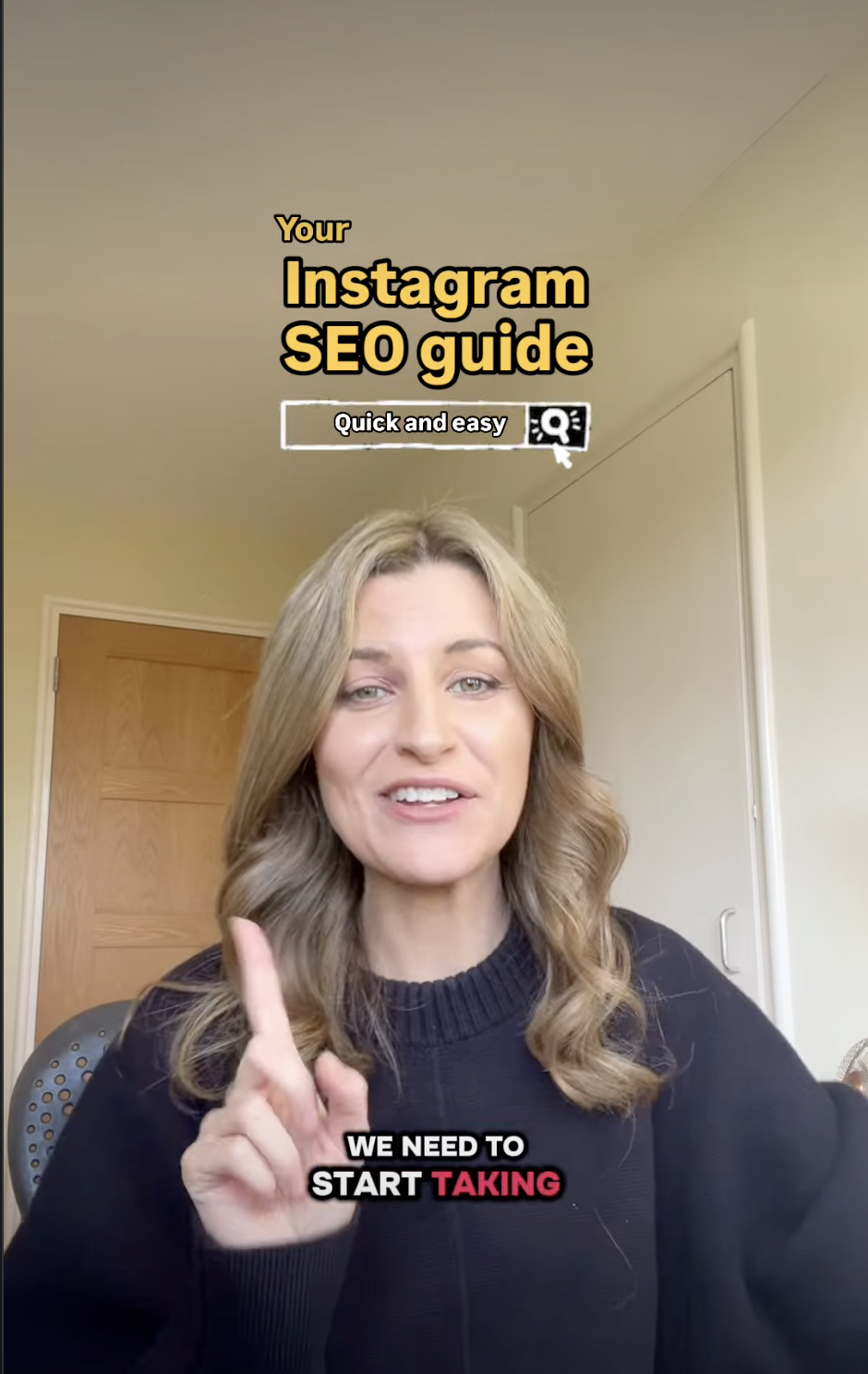
Here is a live example: This reel shows up on Google and on Instagram when I search for the keyword ‘Instagram SEO’. Look at how she is using Text on overlay and captions.
Since January 2025, Instagram can recommend Reels up to 3 minutes long to non-followers. I’d still keep educational Reels at 30 to 90 seconds, since that length holds watch time. Shorter 7 to 15 second clips work when you are riding a trend. Whatever the length, put your keyword on screen as text in the first three seconds, say it out loud, and rename your audio with a keyword phrase instead of leaving it as “original audio.”
When your caption, your on-screen text, and your audio all say the same thing, Instagram gets a clear read on what your Reel covers.
Optimize your profile for search (bio and name)
Your account gets ranked, not just your posts, so treat your profile as a landing page.
Put what you actually do in your display name, not just your brand. “Maya | Instagram SEO tips” will out-rank “Maya” for the thing you want to be found for, because Instagram reads that name field. Keep your username simple. Write your bio in plain language with your main keywords in it, no keyword soup, just clear. And stay consistent, because the more you stick to one niche, the better Instagram gets at understanding you and showing your content to the right people.
Hashtags in 2026 (less than you think)
Quick myth-buster, because this trips people up.
Hashtags still help, but the rules changed. In December 2025, Instagram started limiting captions on posts and Reels to five hashtags, as Social Media Today reported. Mosseri has said a few specific tags beat a long generic list, and that hashtags help people find you in search without adding reach on their own. Keywords in your caption and profile do far more for search than a wall of hashtags ever will.
The Instagram SEO tools I actually use
If you are hunting for the best Instagram SEO tool, here is the honest answer: no single tool does everything. So here is what I reach for, by job, with the free and paid options side by side.
- Instagram search bar (free): the best free Instagram SEO tool for keyword ideas, straight from autocomplete.
- Virlo: trend intelligence across Reels, TikTok and Shorts, so you see which hooks and topics are breaking out in a niche. It costs far less than Exolyt, which tracks TikTok only.
- AnswerRank: tracking whether AI answers recommend you.
- Instagram Edits: Instagram’s own video editing app, with a teleprompter, an Ideas tab and insights.
- Descript: editing Reels out of longer videos by editing the transcript.
- ManyChat: turning search traffic into DMs with a comment keyword. If the 2026 price change pushes you out, several ManyChat alternatives for Instagram DMs charge a flat monthly price instead of billing per contact.
I partner with Virlo and earn a commission if you subscribe.
Start with the free ones. The Instagram search bar plus a bit of manual research will carry a new account a long way. Add a paid tool when you outgrow guessing and want to see real demand and what is working before you post.
Search is bigger than Google now
Google used to be the only search engine for a long time. But with the rise of AI, Generative Engine Optimization, Social media like Tiktok and Instagram, this is different now.
Your Reels get found in three places now, not one. Inside Instagram search, in Google, and in AI answers, when someone asks ChatGPT or Google’s AI for a recommendation and it names sources.
Can Instagram posts show up on Google?
Yes. Since July 10, 2025, public posts and Reels from professional accounts whose owners are 18 or older can appear in search engines. This covers content posted from January 1, 2020 onward. You can switch it off with the setting “Allow public photos and videos to appear in search engine results”, though your profile details may still show up.
The good news is that optimizing for Instagram search feeds all three, because the same clear keywords and authority signals travel across them.
AI answers are still new. I use AnswerRank to check whether AI engines actually mention me and my clients when people ask for recommendations in our space. If you are building a brand, that visibility is worth tracking now, while it is still early and cheap to win. But AnswerRank is the better tool only when you have a brand website to add onto your personal brand. Otherwise you can go ahead with the rest of the updates on your account and use Instagram’s Edits app to shoot content.
There are a few mistakes to avoid
Keyword stuffing reads as spam to people and blurs your topic, so write like a human. Instagram caps hashtags at five anyway. A weak first three seconds kills watch time before ranking even enters the picture. Silent, text-free Reels give Instagram nothing to read, so it does not know what to do with them. These reels, if have a solid visual hook, can get recommended on Discovery engine. However, for SEO it is of no use.
And one last thing: switching niches every other week stops Instagram from ever learning what you are about, which quietly caps everything else.
How to tell it is working
Search your target keyword inside Instagram and see if you surface. Watch the reach coming from the “search” and “explore” sources in your Instagram Insights, since that is search working. In the client accounts I have worked on, that search-source reach was the number that moved once we aligned the caption, on-screen text, and audio on a single keyword, well before the follower count caught up. And track your sends and saves, because those are the signals of durable, searchable value, the kind that keeps pulling views weeks later, not the kind that spikes and dies.
Frequently asked questions
What is Instagram SEO?
Instagram SEO is optimizing your profile, captions and Reels so Instagram shows your content in search. It means placing keywords where Instagram reads them, your name, bio and caption, so the platform knows what to rank you for.
How do I rank higher in Instagram search?
Put your keyword in your name, bio and caption, and say and show it in your Reels. Keep watch time high with a strong first three seconds, earn sends and saves, and stay consistent in one niche.
How many hashtags should I use on Instagram in 2026?
Up to five. Instagram began limiting captions on posts and Reels to five hashtags in December 2025. A few specific hashtags help people find you in search, but they do not add reach on their own.
Does alt text help Instagram SEO?
Instagram describes alt text as an accessibility feature and has not confirmed it as a search signal. Writing a short, keyword-relevant description is still worth doing, because it helps people using screen readers and costs nothing.
How do I do SEO for Instagram Reels?
Put your keyword on screen in the first three seconds, say it out loud, use it in the caption’s first line and rename your audio with a keyword phrase. Instagram has recommended Reels up to 3 minutes long to non-followers since January 2025.
Does Instagram content show up in Google search?
Yes. Since July 10, 2025, public posts and Reels from professional accounts whose owners are 18 or older can appear in Google and other search engines. This covers content posted from January 1, 2020 onward.
How do I stop my Instagram posts appearing on Google?
Switch off the setting that lets public photos and videos appear in search engine results, in your account’s privacy settings. Your profile details may still appear in search results.
What is the best Instagram SEO tool?
There is no single best tool. Instagram’s search bar is the best free tool for keyword ideas, and SEMrush or Ahrefs show Google demand for a topic. Virlo shows trending hooks across Reels, and AnswerRank tracks AI-answer visibility.
How long does Instagram SEO take to work?
Usually a few weeks to a couple of months. Search visibility builds as Instagram learns your niche and your content collects watch time and shares, so it starts slower than a viral spike and lasts longer.
What are Instagram SEO keywords and where do I put them?
They are the search terms your audience uses. Place them in your name field, your bio, the first line of your caption, your on-screen Reel text and your audio title. Aligning all of them gives Instagram one clear topic.
How do I optimize my Instagram bio and profile for SEO?
Put what you do in your display name, keep your username simple, write a plain-language bio with your main keywords, and stay consistent in one niche. Instagram ranks accounts as well as posts, so your profile is a ranking signal.
Where to start
To optimize your Instagram profile for SEO, start with picking one keyword that you want people to know you for:
SEO Expert, Plumber, Social media manager, Electrician, Travel guide etc…
Put it everywhere on Instagram reads, build Reels where the audio, text, and caption agree, and stay in your niche long enough for the platform to trust you on it.
Do this on your next Reel before you post it, not after. And if you want to see what is actually worth ranking for, and whether AI answers are already naming you, the tools above are where I would start. If you have any questions, feel free to ask in the comments or drop me an email. Happy to help.
The Letter
Get the next article in your inbox.
What I am building, as it happens. The experiments, launches and numbers behind my own one-person business, including what did not work.
The tools, tested before I recommend them. Short notes on the platforms I try for selling courses, running a community and sending email, before they become full reviews.
The inner side of the work. Ideas on focus, meaning and energy for solo founders who want a business that feels as good as it performs.
Get The Letter in your inbox
One short email, usually weekly. You can unsubscribe any time.
Keep reading
More from Marketing strategies.