Virlo Review: Great Video Analytics But One Problem

Most creators don’t have a content problem. They have a data problem.
Imagine discovering a trend right before it peaks or while it’s already getting bigger. This is the perfect time to jump in. Algorithm rewards it over anyone who is already late to the game because it serves in its favor.
And imagine a tool that actually tells you exactly that.
That’s the gap Virlo AI seems to fix as a short-form video analytics platform that tracks what’s trending on TikTok, YouTube Shorts, and Instagram Reels before it goes mainstream.
But is it really worth the hype?
For this Virlo review, I spent a few days exploring Virlo, its API and its competitors in the space. I wanted to know whether $49 a month is justified for a creator who is serious about growth.
Affiliate disclosure: Some links on this page are affiliate links. If you buy through them, I may earn a commission at no extra cost to you. I will appreciate if you use them.
What Virlo Actually Is
Virlo.ai launched on March 1, 2025. By January 2026, its own year-in-review reported 62,115 registered users and 3,261 paying subscribers, in a relatively small market… Small in a sense that only educated creators are paying attention to ‘data’.
I have talked about community monetization with Whop and Skool in the past. However, getting new people to your business through content is a critical part of building an online business. And this is incomplete without knowing what is working on algorithms.
The product is more like an intersection of trend intelligence and content strategy. Virlo says its index covers more than 2 million short-form videos and that it tracks 20,000+ creators daily. The idea is that by the time something appears on your feed, the window has already started closing.
A lot of creators are running the same content across TikTok, Reels, and Shorts. Separate tools for each platform means fragmented data and twice the manual work. Virlo covers all three in a single dashboard which is going to be more and more relevant.
Nicolas Mauro and Deniz Sancar founded Virlo, and Red Lab, LLC, a US company, runs it. Mauro’s pitch is that creators already operate as businesses, so they need real data they can act on.
So it does seem to be built for people who post several times a week and need to know what to make tomorrow.
Using Virlo: The First Few Things You’ll Notice
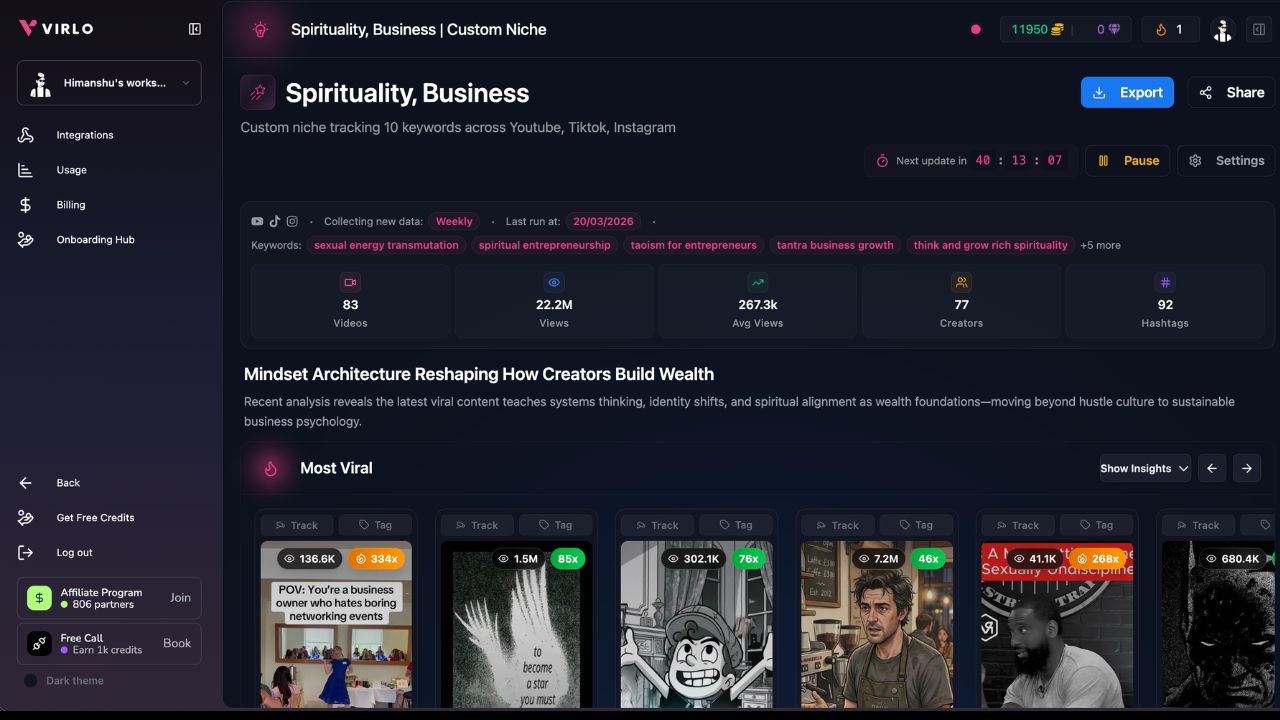
The dashboard doesn’t ask much of you. Land on it for the first time and the layout is already telling you something: niche breakdown on the left, trending content surfaced by category, outlier videos flagged in a separate view.
The Content Research Agent (called Orbit Search when I tested it, and still Orbit in the API) is the core feature. You type in your market, let’s say, fitness, home organization, e-commerce, and Virlo returns a feed of emerging content along with an AI report breaking down hooks, sentiment, and what’s driving engagement. It’s the kind of thing you’d previously spend an hour doing manually and still not do as well.
What Virlo Can Actually Do
Trend Discovery: Finding What’s About to Blow Up
The core promise of Virlo is predictive trend intelligence. It isn’t just pulling a “trending” list from TikTok’s Discover page. The platform tracks emerging hashtags, audio clips, and content formats across all three short-form platforms.
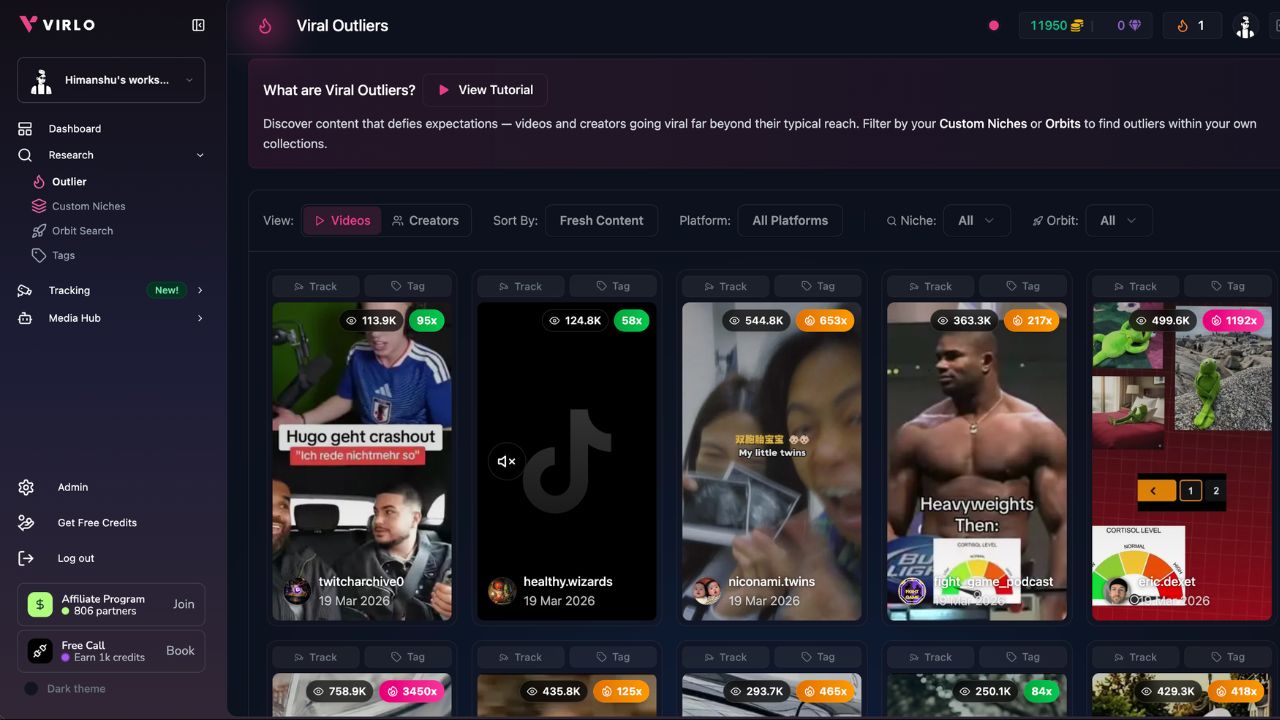
There’s a specific feature called viral outlier detection that surfaces videos breaking typical engagement patterns for their follower count.
I don’t know how the algorithm works in the backend, but while I was testing it, I thought of it like this:
A video getting 2 million views from an account with 4,000 followers is a signal. The niche around it might be opening up. That’s the first-mover window. And most creators never see it because they’re not looking at the right data.
So there is definitely an edge over manually tracking all the data.
Research agents and custom alerts
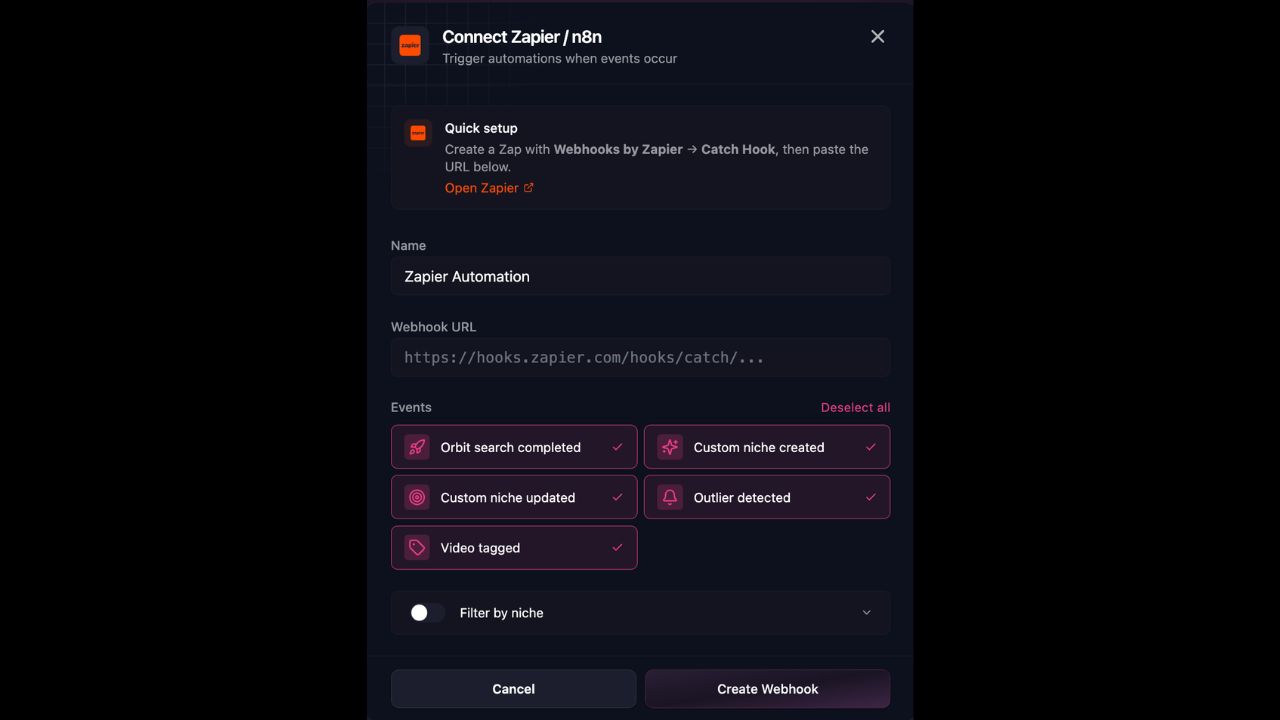
This is the feature that replaces a significant chunk of manual research for agencies and teams. You define your market, specific keywords, competitor accounts, client verticals and Virlo scrapes them continuously. When something breaks out, you get an alert pushed to wherever your team already operates: Slack, Discord, Zapier, n8n. They also have APIs for this which I am gonna discuss later below.
If you are a solo creator, this means waking up to an alert that a specific type of content is gaining traction in your space before your competitors have noticed.
For an agency handling multiple clients the monitoring runs around the clock, without an extra employee.
Creator Tracking
You can paste any TikTok, Reels, or Shorts URL into the Tracking Center and Virlo starts collecting daily snapshots, followers, views, engagement rate. And it builds out a performance history over time.
This analysis which it layers on top is definitely more useful than raw data that you get from default studio for comparision. It can present hook patterns, sentiment analysis, posting frequency correlations, what formats are consistently outperforming for that specific account.
The competitive intelligence use case here is obvious. If five accounts in your niche are consistently outperforming, you want to know exactly what they’re doing differently. So you get to know not just that they post “engaging content,” but which hook structures, which content formats, which posting windows. Virlo puts that in a readable breakdown rather than a spreadsheet.
The AI Content Creation Suite
Virlo added a content generation layer on top of the analytics infrastructure recently. With this, once you’ve identified what’s trending, you can use the AI Script Generator to turn that insight into a draft, a script built around the trend, formatted for short-form.
There’s also video generation with Sora 2 and Veo 3, image generation with Gemini, and ElevenLabs voiceovers for faceless content.
The analytics and trend tools are the reason to subscribe. The AI generation suite is genuinely useful, especially for creators building volume, but it’s still newer than the core product. Experienced video creators with an established style probably won’t replace their process with it. For podcasts and talking-head videos, I still edit in Descript. So if you already have a system in place, this might not be something you will be using right away.
Data Export and Integrations
Every plan includes Excel, CSV and JSON exports, plus a branded PDF report. You can also integrate your workflow with Slack, Discord, Webhooks, Zapier, n8n and other tools, and Virlo offers an MCP server for AI assistants. This can be useful to add it to your Openclaw, agentic workflow or even human workflows.
Virlo AI’s User Experience Review
I spent quite some time to understand how other people are using the tool since I personally don’t have a huge audience to directly deploy it. Overall it seems to be one of the best tools in the market… however not everything is perfect.
Virlo holds a 4.1 TrustScore on Trustpilot from 94 reviews. The complaints cluster on charges after a trial or cancellation and slow email replies. There is not much on Reddit yet.
Some users say they grew a YouTube Shorts channel from scratch to over 15M views with it. I also found one creator who made roughly $10,000 in revenue over two to three months of posting.
I feel the common pattern I could notice is it replaces the brainrot scroll with meaningful signals that actually grows the business.
However, In my research I could also see not everything is perfect. One common issue I faced was if the niche is very narrow you will find inconsistent freshness. While it won’t be an issue most of the time, this might annoy you if you are too specific about your content.
Another point to note is that the platform launched in March 2025, so its dataset is still young. The data coverage is deep across popular categories but there are some gaps in hyper-specific or regional niches. So it might lack complete information in your niche.
How Much Does Virlo Cost?
Virlo has three plans:
- Starter: $49 a month, or $34 a month billed yearly, with 2,000 credits
- Pro: $199 a month with 12,000 credits, 3 team seats and 6 account connections
- Enterprise: from $499 a month with 20,000 credits
Every plan includes Content Research Agents, the COO agent, account tracking, outlier detection and data exports. Virlo’s own pages disagree on which plan adds Meta Ads data, alerts and Zapier, so the current plan cards are worth checking. The API is billed separately, pay as you go, from a $10 deposit.
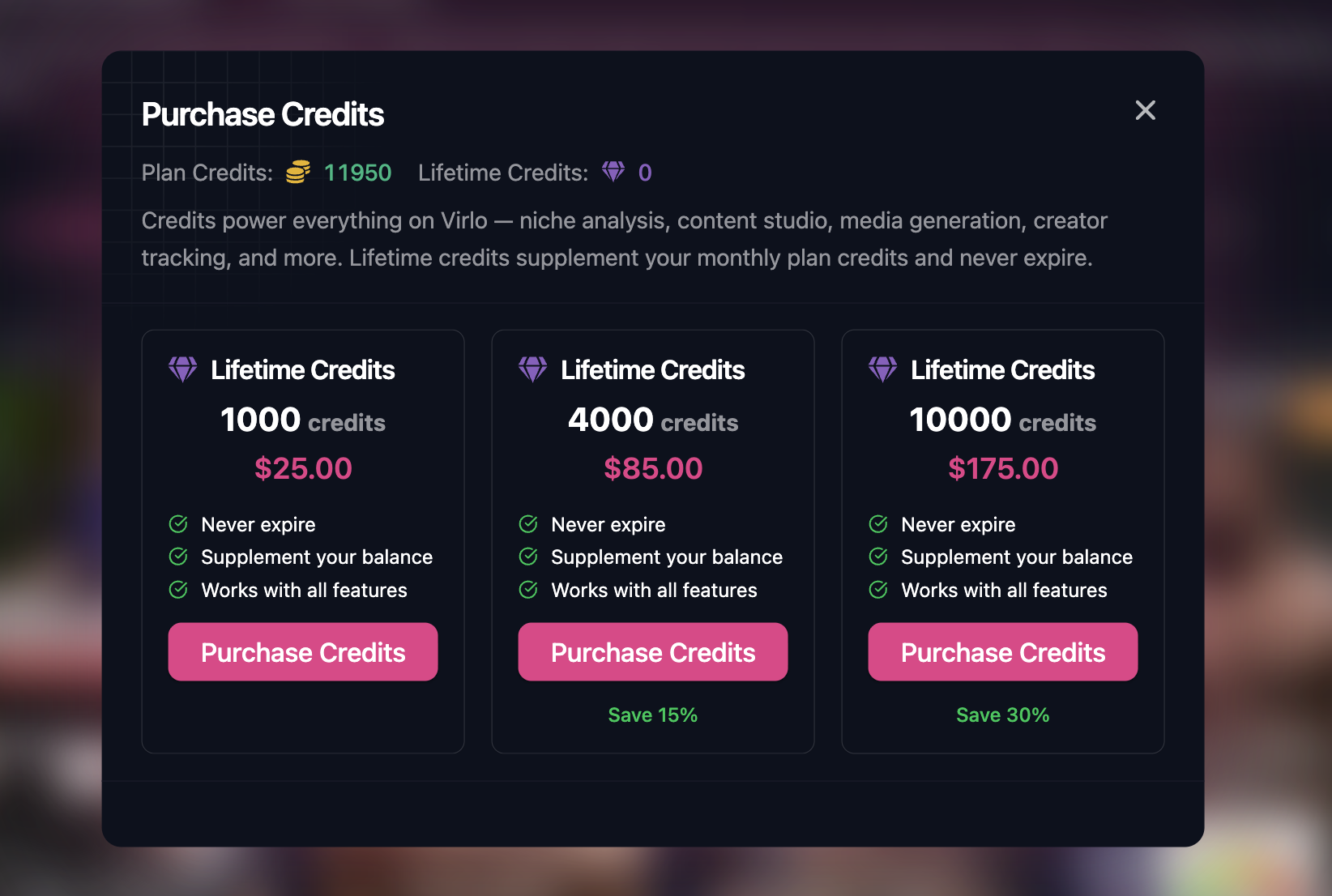
The nuance is the credit system that runs alongside the subscription. A Content Research Agent run costs 100 credits, so Starter’s 2,000 credits cover about 20 research runs a month before custom niche tracking takes its share.
For a creator who uses the platform a few times a week checking niche trends, running a weekly research agent, tracking three to five competitor accounts the base plan is genuinely affordable. The friction comes when you’re running research agents daily across multiple verticals, which is more of an agency workflow. At that usage level, the credit spend adds up and the pricing conversation changes.
Exolyt, for example, the closest enterprise alternative, has a free Basic plan, paid plans that start at about $400 a month, and covers TikTok only. Shortimize, another alternative, starts at $99 a month and focuses on tracking accounts, not AI content tools. Against either of those, Virlo’s price-to-feature ratio holds up clearly for most use cases.
Virlo doesn’t offer refunds after the 7-day free trial. It may refund at its discretion for verified outages longer than 48 hours or billing errors, and unused credits are never refunded. You enter a card at signup and billing starts automatically after day 7, so a cancel reminder helps if you only want to try it.
Is Virlo Worth it?
Virlo is a solid buy if you’re posting short-form video consistently, meaning at least three times per week, and you’re treating content as something more than a hobby.
Also social media managers running accounts across TikTok, Reels, and Shorts will get obvious value from having trend intelligence and competitor tracking in one place rather than stitching together free tools. E-commerce brands, for example, that use short-form as a discovery channel, particularly those testing trending sounds and formats, will also find the outlier detection genuinely useful.
Virlo now covers Instagram Reels too. Spotting a trend is half the job on Reels, because Instagram SEO decides whether people find the Reel in search afterwards.
However, if you are a casual creator posting once or twice a month or if you are into deep content and once a week kinda format, it won’t pay for itself.
Also brands whose social strategy lives exclusively on LinkedIn or X won’t find anything here. And if you need deep compliance-level TikTok audit reporting, the kind a large media company needs for legal review, this is again not the right tool.
So just to put it plainly, it is good if you consider content as part of your core business and you are actively posting on short-form video platforms.
Virlo alternatives
Comparison with other TikTok and YouTube Shorts analytics
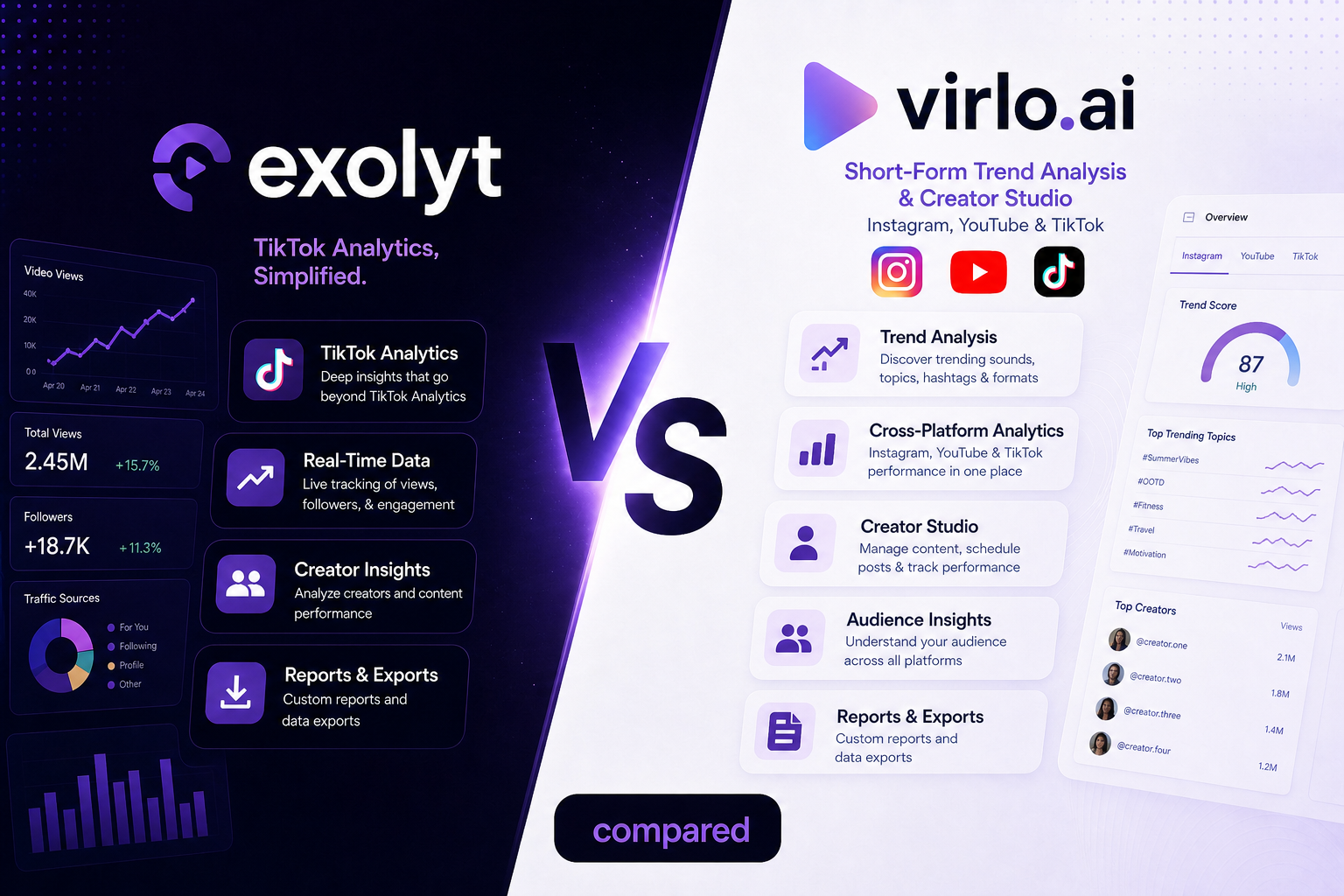
While there are many tools for short form content intelligence, the closest Virlo alternatives are Exolyt and Shortimize.
The comparison that matters most is Virlo versus Exolyt. Exolyt is well built, goes deep on TikTok-only data and is the right call for an enterprise team, with paid plans from about $400 to $950 a month. For a solo creator or a growing brand, that price is hard to justify.
Virlo covers TikTok, Shorts and Reels with trend prediction from $49 a month, which is why Virlo beats Exolyt for most creators and small teams.
Shortimize starts at $99 a month (about $79 billed yearly) and suits agencies. It tracks unlimited accounts across TikTok, Reels and Shorts, and handles creator campaign tracking and payments better than Virlo does, which matters if your workflow is built around monitoring large pools of creators across campaigns. But still, for trend prediction and first-mover content strategy, Virlo is sharper.
You also can use Tiktok and YouTube’s free analytics tools as Virlo alternatives. For example, TikTok’s native analytics tool tells you how your own content performed. It doesn’t show you what’s trending in your niche, and can’t monitor competitors. Also YouTube has a similar studio, but it again lacks the predictive intelligence and cross platform data.
My personal opinion on Virlo as a creator
For creators who post short-form video consistently to build their community and want to make decisions based on something other than gut feeling, Yes, Virlo is worth it.
The trend data is super useful. The platform draws on more than 2 million indexed videos across three platforms, and the outlier detection flags rising videos across accounts, which TikTok and YouTube’s own analytics never show.
At $49 a month, Virlo costs far less than Exolyt’s paid plans, covers three platforms where Exolyt centers on TikTok, and bundles AI content generation with its analytics.
The only time I wouldn’t recommend even giving it a try is; if you don’t have enough content to analyse and post. If you are really starting out and haven’t picked up the momentum you might wanna wait before getting into data analysis.
Virlo API: Orbit, Comet and Satellite
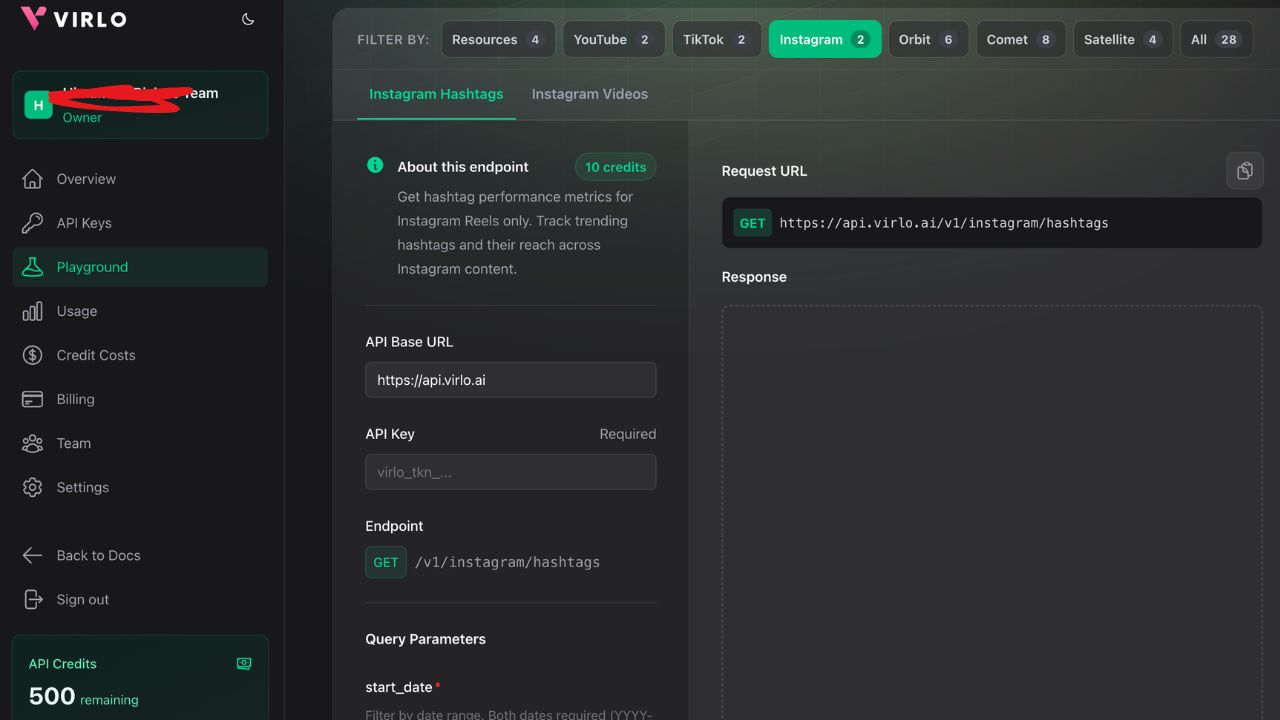
Virlo also runs a public, pay-as-you-go REST API at dev.virlo.ai, priced per call (for example $0.05 per hashtag lookup).
The API covers 25+ endpoints across social listening, creator intelligence, hashtag analytics, trending topics, and platform-specific data. It draws from 2M+ recent viral videos across TikTok, YouTube Shorts, and Instagram, plus Meta Ad Library data.
The three building blocks are Orbit, Comet and Satellite. Orbit handles keyword-based searches that return videos, creator outliers and AI intelligence reports. Comet runs automated niche scraping on a configurable schedule with filters, and Satellite looks up any creator by platform and username.
Developers building creator tools, trend dashboards, AI content apps, or agencies that need Virlo’s short-form video data piped directly into their own reporting stack rather than accessed through the dashboard UI can benefit from it. So for a clean short-form video data API that covers all three major platforms with real trend intelligence the Virlo API is one of very few options that actually does this at scale.
Virlo FAQ
How much does Virlo cost?
Virlo’s Starter plan costs $49 a month ($34 billed yearly) with 2,000 credits. Pro costs $199 a month with 12,000 credits, and Enterprise starts at $499 a month with 20,000 credits.
Does Virlo have a free trial?
Yes. Every plan starts with a 7-day free trial. You enter a card at signup, and billing starts automatically after day 7 unless you cancel.
Can I get a refund from Virlo?
Virlo does not refund subscriptions after the 7-day trial, monthly or yearly. It may refund at its discretion for verified outages longer than 48 hours or billing errors, and unused credits are never refunded.
Does Virlo support Instagram Reels?
Yes. Virlo now covers Instagram Reels along with TikTok and YouTube Shorts, and it also pulls Meta Ads Library data.
Does Virlo have an API?
Yes. Virlo’s REST API has 25+ endpoints, pay-as-you-go pricing and three main parts: Orbit for keyword research, Comet for scheduled niche scraping and Satellite for creator lookups.
Is Virlo legit?
Yes. Red Lab, LLC, a US company, runs Virlo, which launched in March 2025 and holds a 4.1 TrustScore on Trustpilot from 94 reviews. The main complaints are charges after a trial or cancellation and slow email replies.
Is Virlo worth it?
For creators and small teams posting short-form video three or more times a week, yes. For anyone posting once or twice a month, the credits will not pay for themselves.
Virlo vs Exolyt: which is better?
Virlo is better for creators and small teams: it covers TikTok, Shorts and Reels from $49 a month and adds AI content tools. Exolyt suits enterprise TikTok social listening, with paid plans from about $400 a month.
The Letter
Get the next article in your inbox.
What I am building, as it happens. The community experiments, launches and numbers behind my own work, including what did not work.
The tools, tested before I recommend them. Short notes on the platforms I try for running communities, courses and email, before they become full reviews.
The inner side of the work. Ideas on focus, meaning and energy for creators who want a business that feels as good as it performs.
Get The Letter in your inbox
One short email, usually weekly. You can unsubscribe any time.
Keep reading
More from Community building.