Maslow’s Pyramid: The Psychology Framework That Explains Why You’re Stuck

You’ve probably seen the pyramid.
Five colorful tiers stacked on top of each other, each representing a different category of human needs.
Maybe you encountered it in a psychology class and forgot about it. Maybe you’ve seen it referenced in self-help books or business seminars.
Or maybe you’re a founder or creator trying to understand why you feel stuck, unmotivated, or unfulfilled despite doing “everything right.”
Whatever brought you here, you’re asking the right question.
Maslow’s Hierarchy of Needs is a framework for one of the most fundamental questions of human existence: What drives us?
More importantly, it explains why you can’t seem to focus on your dreams when fundamental aspects of your life feel unstable. Why motivation disappears when you’re exhausted. Why purpose feels meaningless when you’re lonely.
Used as a diagnostic, the pyramid can help you understand yourself and the business you’re building.
I don’t consider this framework a completely accurate picture of human needs. It is still one of the most useful maps I know for finding where you’re stuck.
What Is Maslow’s Hierarchy of Needs? (And Why Should You Care)
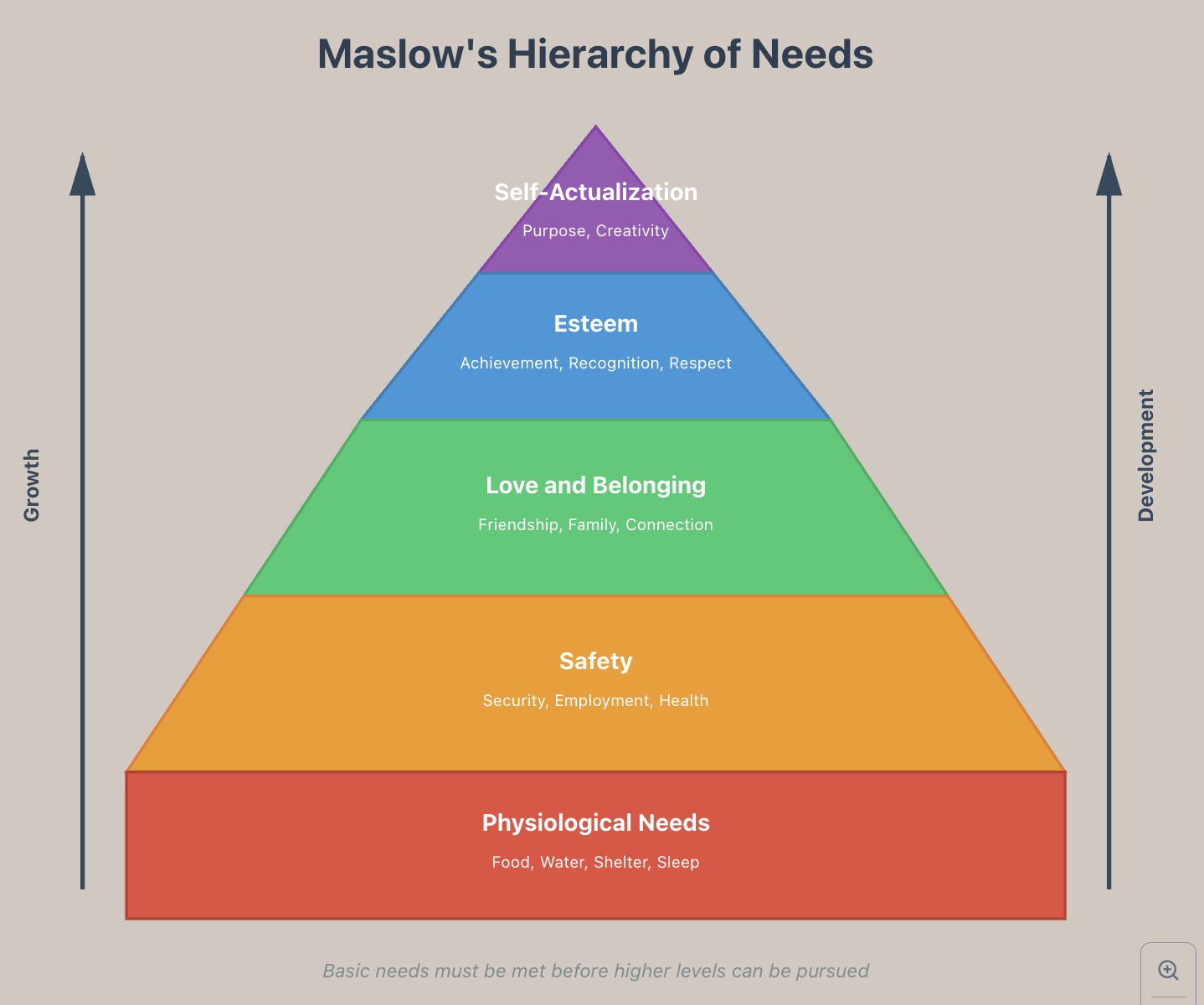
In 1943, psychologist Abraham Maslow published a paper titled “A Theory of Human Motivation” in Psychological Review. It would fundamentally change how we understand human behavior.
His central insight was deceptively simple but profoundly revolutionary: human needs exist in a hierarchy, and higher-level needs become hard to pursue while more basic needs go unmet.
Think of it like building a house.
You can’t install a chandelier on the third floor if you haven’t poured the foundation. You can’t paint the walls if the roof is leaking. You can’t decorate the bedroom if you don’t have electricity.
The same logic applies to human motivation and well-being.
You can’t pursue self-actualization (becoming your most whole self) if you’re sleep-deprived and malnourished. You can’t focus on finding your purpose if you’re worried about paying rent. You can’t build meaningful work if you feel completely alone in the world.
Maslow’s hierarchy remains one of the best-known theories in psychology. It is applied across fields from education to business to healthcare.
For you personally, it works as a diagnostic framework for understanding exactly where you’re stuck and what needs attention first.
Who Drew Maslow’s Pyramid?
Maslow never drew his hierarchy as a pyramid. Management scholars Todd Bridgman, Stephen Cummings and John Ballard traced where the shape came from in a 2019 paper in Academy of Management Learning & Education.
They found that Keith Davis’s 1957 management textbook showed the needs as steps inside a triangle. The pyramid we know today first appeared in 1960, in a Business Horizons article by consulting psychologist Charles McDermid titled “How Money Motivates Men.”
McDermid presented the pyramid as a way to motivate employees at the lowest cost. In an interview with Scientific American, the authors say they found no earlier pyramid.
Maslow himself described people moving back and forth between levels and working on several needs at once. The pyramid works best as a rough map of priorities, not as a strict ladder.
The Five Levels: A Deep Dive Into What Actually Drives You
Maslow identified five distinct categories of human needs, arranged in a hierarchical order from most fundamental to most refined.
The levels look different for each person. Circumstances, environment and personal values shape what each need means in practice.
Physiological Needs (Level 1): The Foundation Everything Else Builds On
At the base of the pyramid are physiological needs: food, water, sleep, shelter, clothing, and other biological necessities for survival.
These are non-negotiable. Your body will always prioritize these needs above everything else because without them, you literally cannot function.
Here’s what this looks like in real life:
When you’re sleep-deprived, activity drops in your prefrontal cortex. That is the part of your brain responsible for decision-making, planning, and self-control.
A 2017 review in Nature Reviews Neuroscience describes how sleep loss impairs sustained attention and skews how the brain responds to rewards, raising impulsivity and risk taking. You’re not lazy when you can’t focus after four hours of sleep. Your brain is protecting you by refusing to engage in complex tasks when it’s operating in survival mode.
When you’re hungry, your blood sugar drops and your cognitive function plummets. You become irritable, impulsive, and unable to think clearly.
Why this matters for you:
If you’re struggling with motivation, focus, or emotional stability, the first question isn’t “What’s wrong with my mindset?” It’s “When was the last time I actually took care of my body?”
Most people skip this level entirely. They try to optimize their productivity while running on five hours of sleep. They chase their dreams while surviving on coffee and stress. They wonder why they can’t perform at a high level when their body is barely surviving.
Your physiological needs aren’t luxuries you earn after success. They’re the prerequisites for everything else.
Practical application:
Before you try another productivity system or motivational strategy, ask yourself:
- Am I getting the 7 or more hours of sleep recommended for adults on most nights?
- Am I eating in a way that nourishes my body, not just fills my stomach?
- Am I moving my body regularly in ways that feel good?
If you answered “no” to any of these, this is your starting point. Not because it’s easy, sexy, or impressive. Because it’s necessary.
Safety Needs (Level 2): You Can’t Build When You Don’t Feel Secure
Once physiological needs are reasonably satisfied, safety needs emerge as the next priority.
Safety needs include:
- Financial security (stable income, savings, ability to cover basic expenses)
- Physical safety (secure housing, safe neighborhood, freedom from violence)
- Health security (access to healthcare, insurance, ability to address medical needs)
- Emotional safety (stable relationships, predictable environment, freedom from constant threat)
This is where many people get stuck without realizing it.
You can have all the proper habits and still feel completely unmotivated if your safety needs are unmet. Because when you don’t feel safe, your nervous system activates a threat response that makes long-term planning nearly impossible.
The American Psychological Association notes that long-term stress wears down the body and is linked to anxiety, depression, high blood pressure and sleep problems. Financial insecurity, housing instability and unsafe environments are common sources of that stress. Your entire nervous system can end up operating as if a predator is chasing you.
And you can’t pursue your dreams when your brain thinks you’re being chased.
What this looks like in real life:
You set goals and make plans, but you can’t seem to take action. Not because you’re lazy, but because every time you try to move forward, a voice in your head says: “What if this fails and I can’t pay rent?” or “What if I invest in this and lose everything?”
You tell yourself you should take risks, but your body won’t let you. Because your body is doing its job. It is prioritizing survival over growth.
You watch other people make bold moves and wonder what’s wrong with you. But what they have that you don’t isn’t courage or confidence. It’s safety. They have a financial cushion. They have stable housing. They have a fallback plan. Their nervous system isn’t in constant threat mode.
The uncomfortable truth about safety needs:
You can’t mindset your way out of genuine financial insecurity. You can’t manifest safety when your environment is actually unsafe. You can’t “think positive” through housing instability.
Sometimes the most productive thing you can do is get a stable job, even if it’s not your dream job. Sometimes the best decision is to move out of a toxic living situation, even if it feels like starting over.
Sometimes taking care of your safety needs means making choices that don’t look ambitious but create the foundation for everything else.
Practical application:
Honestly assess your safety situation:
- Do I have a stable income that covers my basic expenses with some buffer?
- Is my housing situation stable and secure?
- Do I feel physically safe in my environment?
- Am I in relationships or situations that keep me in constant threat mode?
If the answer to any of these is “no,” your first job isn’t to chase big goals. It’s to create safety, not because you’re playing small, but because you’re building a foundation.
Love and Belonging Needs (Level 3): The Social Foundation of Motivation
You can have perfect habits, unlimited motivation, and crystal-clear goals. You can still feel empty if you don’t have a genuine human connection.
Love and belonging needs include:
- Intimate relationships (romantic partners who truly see you)
- Deep friendships (people who know and accept the real you)
- Family connections (healthy relationships with family or chosen family)
- Community belonging (feeling part of something larger than yourself)
- Being seen and understood (having people who “get” you)
Humans are fundamentally social creatures. We evolved in tribes. We survived because of cooperation. We’re literally wired for connection at a neurological level.
A 2010 meta-analysis led by Julianne Holt-Lunstad at Brigham Young University pooled 148 studies with 308,849 participants. People with stronger social relationships had a 50% greater likelihood of survival over the study periods. The authors judged that effect comparable with quitting smoking. But the impact goes beyond physical health.
What this actually feels like:
You accomplish something you’re proud of, and your first thought is: “Who can I tell?”
And then the crushing realization: no one would really understand why this matters to you.
You scroll through social media, seeing everyone’s highlight reel and feel more alone than ever. Because surface-level connection isn’t connection at all. It’s performance.
You’re in a relationship or surrounded by people, but you still feel invisible. Being physically around people while feeling unseen is worse than being alone.
You work hard on your goals, but it all feels meaningless because there’s no one to share the journey with.
The worst kind of loneliness isn’t being alone. It’s being surrounded by people and still feeling invisible.
You can have a thousand social media followers and zero real friends. You can be married and still feel profoundly lonely. You can be part of communities and still not belong.
A large following is an audience, and an audience is not the same as a community. Followers relate to you, while a community connects members to each other, and only that second kind meets the need to belong.
What you need isn’t more people in your life. It’s the right people. People who see you. People who challenge you. People who celebrate your wins and hold space for your losses.
Practical application:
Get brutally honest about your connection needs:
- Do I have at least 2-3 people I can be completely real with?
- When I accomplish something, do I have people who genuinely celebrate with me?
- Do I feel part of a community that shares my values and interests?
- Am I in relationships that energize me or drain me?
If your belonging needs are unmet, this isn’t something you can power through. It helps to build connections actively: join communities around your interests, reach out to people you admire, and allow yourself to be vulnerable in relationships.
Because motivation without connection is unsustainable. Eventually, you’ll ask yourself: “What’s the point?” And without people who matter, you won’t have a good answer.
Esteem Needs (Level 4): The Confidence That Comes From Evidence
Esteem needs are about self-respect, confidence, achievement, and recognition.
This level is split into two categories:
- Lower esteem needs: Respect from others, status, recognition, attention, reputation
- Higher esteem needs: Self-respect, self-confidence, competence, achievement, independence
Most people focus on the lower needs (what others think) when what they actually need is higher esteem (what they think of themselves).
Here’s why this level matters so much:
You can have all the motivation techniques in the world, but if you don’t actually believe you’re capable of following through, none of it will work.
Esteem needs are about having objective, tangible evidence that you can do hard things. That you keep your promises to yourself. That you are who you say you are.
What low self-esteem looks like:
You set goals enthusiastically and then abandon them at the first obstacle. Not because you don’t care, but because deep down, you never expected yourself to follow through anyway.
You compare yourself to others constantly. Not to inspire yourself, but to confirm your belief that you’re not good enough.
You achieve something and immediately discount it: “It wasn’t that hard,” or “Anyone could have done that,” or “I just got lucky.”
You need constant external validation because you don’t trust your own judgment.
The research on esteem and motivation:
Self-efficacy is the belief in your ability to succeed. A 1998 meta-analysis by Alexander Stajkovic and Fred Luthans found a significant positive link between self-efficacy and work performance. Albert Bandura, who introduced the concept in 1977, argued that it shapes how much effort people invest and how long they persist against obstacles.
But here’s the paradox: you can’t think your way into self-efficacy. You have to earn it through action.
How to build genuine esteem:
Start with embarrassingly small commitments and keep them.
Not because small goals are impressive. Because every time you do what you say you’ll do, you’re building evidence that you’re trustworthy to yourself.
You can’t expect yourself to run a marathon when you haven’t proven you can run a mile. You can’t expect yourself to build a business when you haven’t proven you can show up consistently for a week.
Your self-esteem isn’t built through affirmations or positive thinking. It’s built through accumulated evidence of integrity with yourself.
Practical application:
Honestly assess your esteem level:
- Do I genuinely believe I’m capable of achieving my goals?
- What evidence do I have that I follow through on my commitments?
- Am I seeking external validation because I don’t trust myself?
- When was the last time I kept a promise to myself?
If your esteem is low, don’t set bigger goals. Set smaller ones. Prove to yourself that you’re someone who does what they say. Build evidence. Build self-respect. Build the foundation of confidence that comes from integrity, not inspiration.
Self-Actualization Needs (Level 5): Becoming Who You’re Capable of Being
At the peak of the pyramid is self-actualization: the desire to become the fullest expression of yourself.
Maslow described self-actualization as “the desire to become more and more what one is, to become everything that one is capable of becoming.”
This isn’t about achieving external success or accumulating accomplishments. It’s about becoming.
Self-actualization includes:
- Pursuing personal growth for its own sake
- Developing your unique talents and potential
- Seeking truth, beauty, justice, or meaning
- Creating work that expresses your authentic self
- Experiencing “peak experiences” (moments of profound joy, clarity, or connection)
This is the level everyone wants to operate at. Purpose. Flow. Meaning. Creating work that matters.
In Maslow’s view, self-actualization is hard to pursue when lower needs are chronically unmet. In his 1943 paper, he wrote that this need emerges once the physiological, safety, love and esteem needs are satisfied.
What Maslow found about self-actualized people:
In his book Motivation and Personality (1954), Maslow identified several characteristics common among self-actualized individuals:
- They have a realistic perception of reality and are comfortable with uncertainty.
- They accept themselves and others as they are, without excessive guilt or shame.
- They’re spontaneous in thought and action, focused on problems outside themselves rather than ego concerns.
- They need privacy and comfort with solitude.
- They’re autonomous and independent of culture and environment.
- They have a fresh appreciation for life and peak experiences.
- They have deep, satisfying relationships with a select few rather than superficial relationships with many.
And so on…
The brutal truth about self-actualization:
Maslow saw self-actualization as rare. In his 1943 paper, he wrote that “basically satisfied people are the exception” in society. For illustration, he guessed the average person meets only about 10% of their self-actualization needs.
That gap points to lower-level needs that are still partly unmet, not to laziness.
You can’t pursue your fullest potential when you’re exhausted, unsafe, lonely, or constantly doubting yourself.
And yet, this is exactly what most self-help advice tells you to do. “Find your purpose!” “Live your passion!” “Manifest your dreams!”
It’s terrible advice for people whose foundations are unstable.
Self-actualization isn’t something you achieve once and maintain forever. It’s a continuous process of growth that becomes accessible when your lower needs are sufficiently met.
You know you’re touching self-actualization when:
- Your motivation comes from internal growth rather than external validation
- You’re comfortable with uncertainty and complexity
- You create for the joy of creating, not to prove something
- You’re pursuing challenges because they help you grow, not because you have something to prove
- You feel aligned with your deepest values
- You experience moments of flow where time disappears
- You’re comfortable being yourself regardless of others’ opinions
Don’t force self-actualization when your foundation is unstable.
But when your lower needs are sufficiently met, ask yourself:
- What would I pursue if external validation didn’t matter?
- What problems am I uniquely positioned to solve?
- What creative expression wants to emerge through me?
- How can I continue developing my unique potential?
- What does growth look like for its own sake?
Self-actualization isn’t a destination. It’s a way of being. It’s the ongoing commitment to becoming more fully yourself.
A coach can help, but the kind matters: vertical coaching changes how you think, while horizontal coaching adds skills.
Beyond the Pyramid: What Maslow Got Right (and What He Missed)
Maslow’s hierarchy has been criticized, refined, and expanded since its introduction in 1943. Let’s address the nuances that matter for your actual life.
The Hierarchy Isn’t Always Linear
Maslow never claimed the order was strict. In his 1943 paper, he wrote that the hierarchy is “not nearly as rigid as we may have implied.” He suggested the average person might be 85% satisfied in physiological needs, 70% in safety, 50% in love, 40% in esteem and 10% in self-actualization.
Sometimes people pursue higher-level needs even when lower needs are unmet. Artists create masterpieces while starving. Parents sacrifice safety for their children’s belonging. Activists pursue meaning while risking physical security.
Later research supports that flexibility. Louis Tay and Ed Diener analyzed Gallup World Poll data from 123 countries and found that need fulfillment predicted well-being in every world region. They also found that people reported good relationships and self-actualization even when their basic and safety needs were not fully met.
What this means for you:
You don’t need perfect sleep, complete financial security, or ideal relationships before pursuing meaningful work.
But you do need to be honest about the costs. If you’re pursuing Level 5 goals while Level 1-3 needs are severely unmet, something will eventually break.
Usually, it’s about your health, your relationships, or your ability to sustain the work itself.
Cultural Differences Matter
Maslow’s hierarchy was developed primarily through observation of Western, individualistic cultures. In 1984, Geert Hofstede criticized its ordering as ethnocentric. In more collectivist cultures, acceptance and community can matter more than individual esteem or self-actualization.
The core insight remains valid: humans have hierarchical needs. But the specific ordering may vary based on cultural context and personal values.
Deficiency Needs vs. Growth Needs
Maslow later refined his theory to distinguish between:
Deficiency needs (Levels 1-4): These are needs that arise from lack. When they’re unmet, you feel anxious, stressed, or incomplete. Once satisfied, the motivation to fulfill them decreases.
Growth needs (Level 5): These arise from the desire to grow. Unlike deficiency needs, the motivation to fulfill growth needs can actually increase as they’re satisfied. The more you grow, the more you want to grow.
This distinction explains why success at lower levels doesn’t guarantee fulfillment. You can have all your deficiency needs met and still feel empty if you’re not growing.
Maslow’s Later Addition: Transcendence
In his later work, Maslow added a sixth level: transcendence needs. Psychologist Mark Koltko-Rivera describes this later version in a 2006 paper in Review of General Psychology. These needs involve helping others achieve self-actualization, spiritual experiences, and connection to something beyond the self.
This reflects a truth that many people discover: the highest fulfillment often comes not from personal achievement but from service, contribution, and connection to something larger than yourself. For me, a shamanic breathwork session in Bali was one of those spiritual experiences.
How to Actually Use This Framework in Your Life
Understanding Maslow’s hierarchy intellectually is one thing. Using it as a diagnostic tool for your life is another.
Here’s how to make this practical:
Step 1: Conduct an Honest Needs Audit
Go through each level and rate yourself honestly on a scale of 1-10:
Physiological Needs:
- Sleep quality and consistency: ___/10
- Nutrition and hydration: ___/10
- Physical health and pain management: ___/10
- Overall physical well-being: ___/10
Safety Needs:
- Financial security: ___/10
- Housing stability: ___/10
- Physical safety: ___/10
- Emotional security: ___/10
Belonging Needs:
- Quality of close relationships: ___/10
- Depth of friendships: ___/10
- Sense of community: ___/10
- Feeling seen and understood: ___/10
Esteem Needs:
- Self-confidence: ___/10
- Self-respect: ___/10
- Sense of achievement: ___/10
- Trust in your capabilities: ___/10
Self-Actualization:
- Alignment with values: ___/10
- Creative expression: ___/10
- Personal growth: ___/10
- Sense of purpose: ___/10
Any category where you scored below 6 deserves immediate attention.
Any level below 4 is likely sabotaging your efforts at higher levels.
Step 2: Identify Your Lowest Unmet Need
Look at your audit. Where’s the weakest link?
This is probably where your motivation is dying. This is where your energy is being drained. This is what needs attention first.
Not because fixing it will solve everything. Because not fixing it will undermine everything else.
Step 3: Make It Your Primary Focus
Whatever level needs the most attention becomes your priority.
Not your only focus. But your primary one.
If your physiological needs are in crisis (you’re sleeping 4 hours a night and living on coffee), your job isn’t to build a business. It’s to fix your sleep. Everything else you want to accomplish will be easier once your body isn’t in survival mode.
If your safety needs are unmet (you’re worried about money constantly), your job isn’t to “think abundant.” It’s to create genuine financial stability. That may mean taking a stable job that isn’t your dream.
If your belonging needs are starving (you feel profoundly alone), your job isn’t to achieve more. It’s to build real connection.
Step 4: Build Progressively, Not Perfectly
You need “good enough” at each level to sustainably pursue the next, not 10/10 at every level.
What does “good enough” look like?
- Physiological: You’re sleeping reasonably well most nights, eating in a way that supports your energy, and not in chronic pain
- Safety: You have stable income, secure housing, and generally feel safe in your environment
- Belonging: You have 2-3 people you can be real with and feel part of at least one community
- Esteem: You have evidence that you follow through on commitments and generally respect your own capabilities
Once you have “good enough” foundations, you can start building toward self-actualization while maintaining the lower levels.
Step 5: Maintain Your Foundation While You Build
The biggest mistake people make is getting one level stable and then completely neglecting it while pursuing the next.
You get your sleep dialed in, then sacrifice it chasing a business opportunity.
You build financial stability, then risk it all on a dream without proper planning.
You create deep connections, then ghost everyone when you get busy with work.
This creates a cycle of building and collapse that keeps you stuck.
A steadier approach is to keep each level “good enough” while you grow. That can mean protecting your sleep, keeping your finances stable, nurturing your relationships and continuing to build self-respect.
Growth isn’t about abandoning lower levels. It’s about building on top of a stable foundation.
Using Maslow’s Hierarchy to Build a Community
If you run a community, the pyramid works as a design checklist. Physiological needs sit outside what a community can provide, so the map starts at safety.
- Safety: rules and moderation. Members share openly when they trust the space. Clear rules, consistent moderation and quick action on spam or abuse help them feel safe enough to post.
- Belonging: welcome rituals and small groups. A personal welcome, an introductions thread and small groups or cohorts help new members feel known early on.
- Esteem: recognition and roles. Shout-outs for wins, member spotlights and roles such as moderator or event host show people that their contribution matters.
- Self-actualization: members teaching others. Members grow when they share what they know. Inviting them to run sessions, write guides or mentor newcomers gives them room to do that.
A community that covers these levels gives members a reason to stay beyond the content. That design work starts before launch, when you build a community around one clear purpose and hand-pick your first members.
The Questions This Framework Helps You Answer
Once you understand Maslow’s hierarchy, you can answer the questions that plague everyone pursuing growth:
“Why can’t I stay motivated?” Because you’re trying to pursue Level 5 goals while Level 1-4 needs are screaming for attention, you might feel overwhelmed. Fix the foundation first.
“Why do I feel empty despite achieving my goals?” Because you optimized for achievement (esteem) or money (safety) but neglected belonging or growth. You built a life that looks successful but doesn’t feel meaningful.
“Why do successful people seem to have it easier?” Because they (often invisibly) have their lower needs more securely met. They have financial cushions, support systems, and stable foundations that make risk-taking possible.
“What should I focus on right now?” Whatever level is weakest in your needs audit. That’s where your energy is being drained and where improvement will have the biggest impact.
“How do I know if I’m ready for the next level?” When the current level feels “good enough” that you’re not constantly worried about it. When it’s stable enough that temporary disruptions don’t send you into crisis mode.
The Bottom Line
Maslow’s Hierarchy of Needs is a map for understanding why you feel the way you do. Why motivation comes and goes. Why some goals feel effortless while others feel impossible.
Once you understand it, you can allow yourself to stop chasing self-actualization when your foundation is crumbling.
Start where you actually are. Build from the bottom up. Create stability before you chase meaning.
And watch how everything changes when you stop fighting your needs and start honoring them.
Your needs are the roadmap to becoming who you’re capable of being.
The question isn’t whether you’ll address them. The question is how long you’ll keep trying to build without a foundation.
An ancient Indian answer to why you do what you do reaches a similar place: you become what you think about, and every action shapes the next one.
FAQ
What are the five levels of Maslow’s hierarchy of needs?
The five levels are physiological needs, safety, love and belonging, esteem, and self-actualization. Abraham Maslow described them in A Theory of Human Motivation, published in Psychological Review in 1943.
Did Maslow create the pyramid?
No. Maslow never drew his theory as a pyramid. The earliest known pyramid appeared in Charles McDermid’s 1960 Business Horizons article, How Money Motivates Men, according to a 2019 paper by Todd Bridgman, Stephen Cummings and John Ballard.
Do you have to meet Maslow’s needs in strict order?
No. In his 1943 paper, Maslow wrote that the hierarchy is far less rigid than it looks and that people usually meet each level only in part. A 2011 study of 123 countries by Louis Tay and Ed Diener found that higher needs can lift well-being even when basic needs are not fully met.
How does Maslow’s hierarchy apply to entrepreneurs?
It can help founders find the unmet need behind stalled progress. A founder short on sleep, savings or support may struggle to plan or take risks. Fixing the weakest level first can make higher goals easier to pursue.
How does Maslow’s hierarchy apply to building a community?
Each level from safety upward maps to something a community can offer. Clear rules and moderation create safety, while welcome rituals and small groups create belonging. Recognition and roles meet esteem needs, and members who teach others move toward self-actualization.
The Letter
Get the next article in your inbox.
What I am building, as it happens. The experiments, launches and numbers behind my own one-person business, including what did not work.
The tools, tested before I recommend them. Short notes on the platforms I try for selling courses, running a community and sending email, before they become full reviews.
The inner side of the work. Ideas on focus, meaning and energy for solo founders who want a business that feels as good as it performs.
Get The Letter in your inbox
One short email, usually weekly. You can unsubscribe any time.
Keep reading
More from Productivity.