Skool Discovery Algorithm: How to Rank Your Community in 2026

Skool Discovery is one of the few growth channels that works without an existing audience. People browsing Skool are already looking for a community in your topic, and many of them are used to paying for one.
Skool ranks communities within each category using member growth, member activity (posts, comments, likes) and retention. Its Growth Boost can also promote your group in search and off-site ads, and Skool keeps a commission only on the paying members it brings.
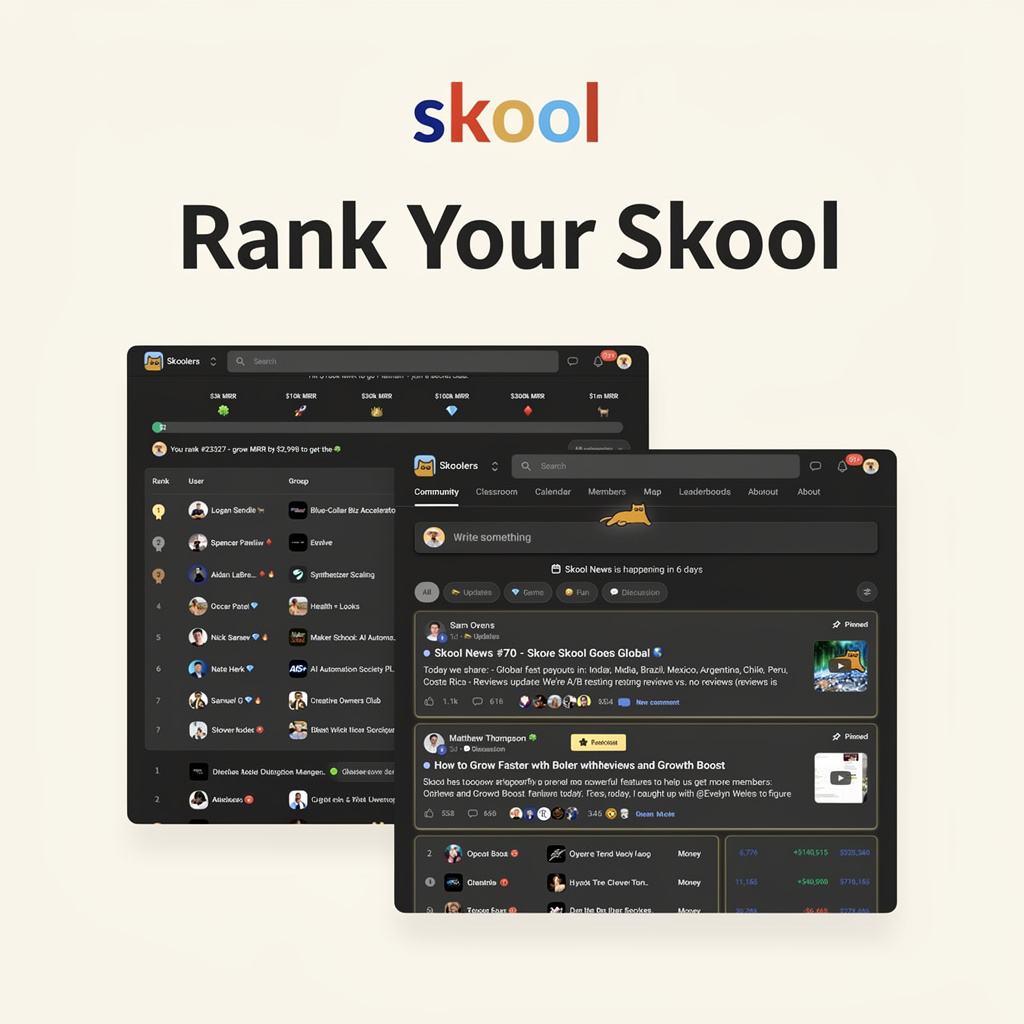
If you run a group on Skool, you have probably seen a few members arrive from Discovery and wondered why some weeks bring more than others.
The ranking signals themselves are not new, though. Skool’s help center listed growth, activity and retention in April 2025. What changed in 2026 is keywords, the Trending tab and clearer traffic reporting, and those decide whether your community’s quality gets seen.
Quality engagement beats raw size on Skool, and the feed, levels and leaderboard are all built around it. I have spent 9 years helping creators and coaches build paid communities, and Discovery has become the most underpriced growth channel on the platform. It also rewards the same work as building a good community itself.
Affiliate disclosure: Some links on this page are affiliate links. If you buy through them, I may earn a commission at no extra cost to you. If you do not want, feel free to not click on them. But I will appreciate if you use them.
What Skool Discovery actually is
The Skool Discovery page is the platform’s built-in marketplace of communities. Anyone browsing skool can search, filter by category, and join free or paid groups directly. Think of it as the app store for communities, with the same dynamic: most people never scroll past the top results.
Every other growth channel demands an audience you have to build first. Discovery sends you people who are already on Skool, already comfortable paying for communities, and actively looking for one in your topic. There is no colder start than zero followers, and Discovery works from zero.
What changed in the 2026 update
Skool rolled the update out in stages during 2026. Circle also runs an opt-in Discover directory, launched in January 2025, but neither Circle nor Heartbeat ranks communities the way Skool does.
Firstly, Search got real. Skool search now matches communities by assigned keywords, not just names. Before this, you needed your topic in your community name to be findable. Now a community called “The Studio” can rank for “pottery for beginners” if the keywords are set right.
Then Community keywords arrived. Owners assign the search terms their community should appear for. This is the closest thing Skool has to SEO, and most owners set them once, badly, and never look again.
We also have a trending homepage. Discovery’s front page now surfaces communities gaining momentum, which gives newer groups a path to visibility that pure size rankings never allowed.
The ranking stayed quality-first. Rankings within each category have weighed growth, activity and retention rather than raw member count since at least April 2025. A person on Skool’s team also reviews rankings and applies boosts and penalties, which makes them harder to game.
And finally, traffic sources. The Growth tab shows where each new member came from over the last 30 days: Invite, Affiliate, Skool network (Discovery, the recommended-groups sidebar and Skool’s ads), External website or Direct. Skool network uses a 14-day attribution window, so Discovery becomes a channel you can measure.
Growth Boost: Skool’s ads for your community
Growth Boost is on by default. It boosts your group in Discovery search and lets Skool run off-site ads for it, and you can switch it off in Settings > Discovery.
Skool pays for the ads and keeps a commission on the paying members it brings: 30% in its own example, or $3 of a $10 price. That cut applies to every recurring charge while the member stays. On members you bring yourself, Skool deducts only its normal transaction fee. You can also change the Growth Boost percentage, and existing members keep the rate they joined at.
Skool says a boost usually shows within 2 to 4 weeks, and the ads can slow down when a group’s stats are weak. It does not recommend Growth Boost for high-ticket offers, where a 30% cut on a $1,000 program is hard to justify.
For a group priced under about $100 a month, keeping it on makes sense, since you pay only for the members Skool brings. Circle’s Discover marketplace is opt-in and has no paid boost like this, so on Circle, growth depends on your own marketing.
How to get listed on Skool Discovery
Skool doesn’t list every group automatically. A group needs a minimum number of members, posts and activity, plus:
- a group description
- About page text and images
- a cover image
You can write the About page and add the cover image while you set up your Skool community, so the group is ready the day it meets the activity minimum. Skool’s team then reviews it, and an approved group usually appears within an hour. Private groups can be listed too: Skool’s own Skoolers group is private and still shows up.
Skool’s Discovery FAQ also lists what its reviewers reward and penalize.
Boosts:
- High-quality artwork and About page
- An interesting niche
- Authentic human engagement
- An active owner and admins
Penalties:
- Bots or fake accounts
- Spam or low-quality engagement
- Low-quality artwork or About page
- Taking payments off-platform
- Bad support
- An inactive owner
New groups also rank lower at first and climb as they age.
The three signals that decide your rank
Skool’s own help center names three ranking inputs. Here is what each one actually measures, and what it rewards.
| Signal | What it measures | What actually moves it |
|---|---|---|
| Member growth | New members joining over recent time windows | A steady join rate, not one big spike |
| Member activity | Posts, comments, and likes | Conversations, not announcements |
| Retention | Whether members stay or leave | Onboarding, habit loops, real value |
Growth is the momentum signal. The algorithm cares more about your trajectory than your total, which is why the trending page exists and why small communities can outrank giants in their category. A group adding twenty members a week with strong engagement reads as healthier than a stagnant group of ten thousand.
Activity covers posts, comments, and likes, and everything Skool has said about quality-first ranking points to rate mattering more than volume. Skool also says removing inactive or level 1 members doesn’t improve your rank, since some people simply like to lurk. What moves the signal is giving the members who do participate a reason to come back daily. Bought or begged-for joins don’t help either, because those members rarely post and often leave.
Then there is retention, the signal Skool’s help center stresses most. It works as the quality filter, and in my experience it is the one that separates communities that hold a ranking from communities that spike and vanish. Skool can see who leaves, how fast, and whether your churn is normal or a warning. A community that people join and abandon within a week tells the algorithm everything it needs to know.
Notice what these three have in common. None of them can be faked for long, and all of them are downstream of the same thing: a community people genuinely want to be in. The algorithm is not asking you to do tricks. It is asking you to run a good community and make it findable. The findable part is where the tactics come in.
How to rank in Skool Discovery, step by step
This is the sequence I use. The order matters, because the early steps determine whether the later ones compound.
1. Check your category, then let keywords do the niche work
Rankings are per category, and Discovery shows nine broad ones plus Trending: Hobbies, Music, Money, Spirituality, Tech, Health, Sports, Self-improvement and Relationships.
You can’t pick a tight niche category, and fixing a wrong one means contacting Skool support. So the category decides who you compete with, while keywords decide which searches you show up for.
2. Set your Skool keywords like a search marketer, not a poet
Your keywords should be the literal phrases your ideal member types, not clever brand language. “Pottery for beginners,” not “creative clay journey.”
Finding them takes ten minutes. Search Skool for your topic and note what autocomplete suggests. Look at which communities rank for those phrases and what words appear in their names and descriptions.
Then assign the keywords that match real searches with the least direct competition. If you have ever done keyword research for Google, this is the same muscle with less data. If you have not, start with the phrase you would type if you were looking for your own community.
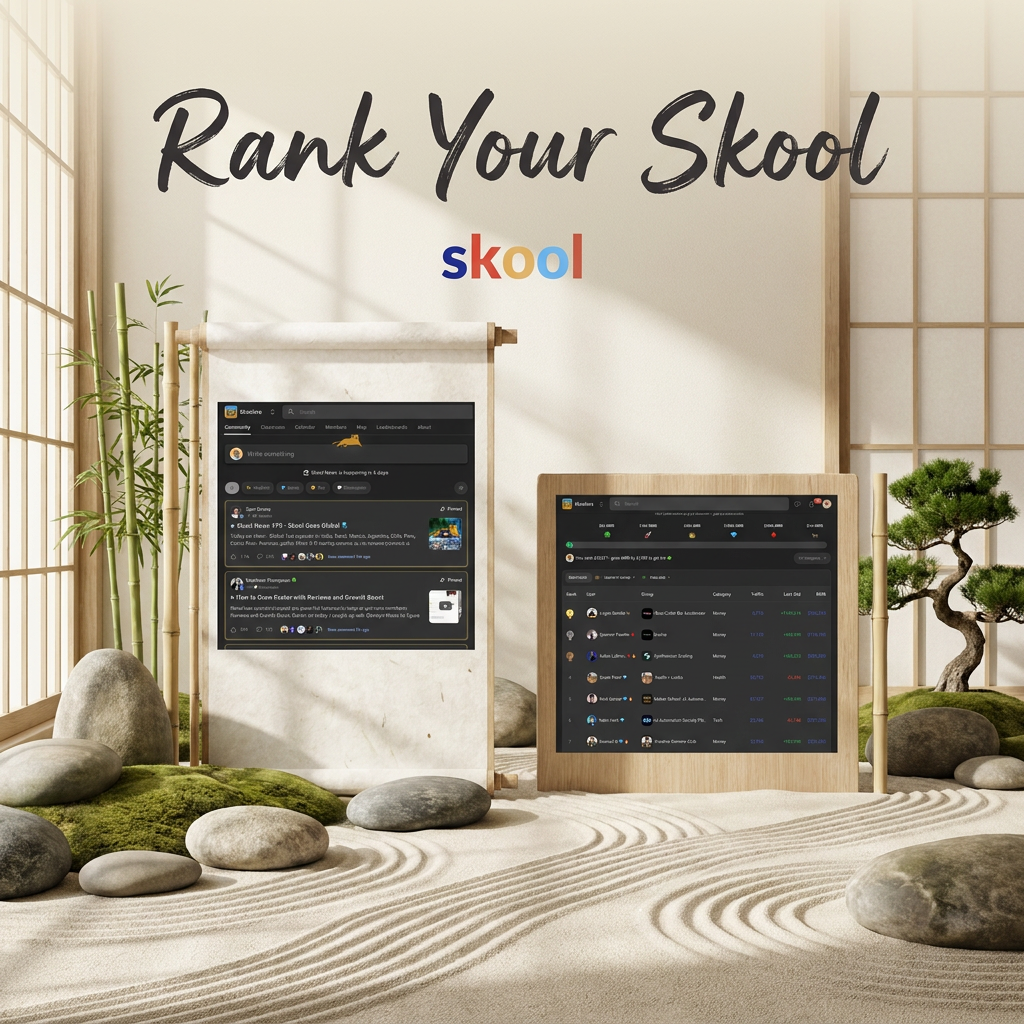
3. Treat your about page like a landing page
Search gets you seen. Your about page gets you joined, and join rate feeds the growth signal. Lead with who the community is for and what they get, show proof if you have it, and make the first line count, because that is what shows in search results. A vague about page quietly kills rankings by wasting the clicks the algorithm gives you.
4. Build one daily activity loop
Activity is a ranking input, so engineer it rather than hoping for it. One reliable loop beats five occasional ones. A daily question thread, a wins post every Friday, a challenge with check-ins. Whatever fits your topic, the test is the same: does an average member have a reason to open Skool today and leave a comment?
Two design notes from communities I have worked with. Prompts that ask for opinions outperform prompts that ask for updates, because opinions generate replies and replies compound the activity signal. And when the owner replies to every early comment, threads run noticeably deeper, because people post more where they know they will be answered.
5. Fix retention before you pour in growth
If people are leaving fast, ranking higher just makes you leak faster, and the churn drags your rank back down. The highest-leverage fix is almost always onboarding: a clear first action for new members within the first day, and a reason to come back within the first week. Communities die from silent exits, not dramatic ones, which is the core of the New Blood Principle. The algorithm now watches those exits.
6. Concentrate your launches into momentum
Because growth is a trajectory signal, timing matters. If you control when members arrive, from a launch, a newsletter push, or a collaboration, concentrate joins into a window rather than dripping them across months. A visible week of momentum can lift you onto the trending page, and the trending page brings members you did nothing to earn. This is the closest thing Discovery has to a flywheel.
7. Check the Growth tab monthly and double down
The Growth tab shows where members actually come from. If Skool network brings them, keep sharpening keywords and protecting your activity loops. If everything still comes from invites and external links, your Discovery presence is not working yet and the first five steps need another pass.
How long does ranking take?
Set expectations honestly, because this is the question I get most. The keyword and about-page changes can show up in search within days, since they are matching problems rather than trust problems. The ranking signals move slower.
Growth, activity, and retention are all measured over time, which means a category rank climbs across weeks of consistent momentum, not overnight.
Skool says Growth Boost usually lifts a group within 2 to 4 weeks. A meaningful category position takes longer, since new groups start lower and climb as they age. If nothing has moved after six weeks, the problem is almost always one of two things: keywords nobody searches, or activity that looks healthy to you and thin to the algorithm. The Growth tab will tell you which.
What does not work anymore
Skool’s human review and penalty list make rankings harder to game, and a few popular tactics now range from useless to harmful.
Engagement bait, the “comment YES below” style of posting, inflates activity briefly and trains members to produce low-value noise. Skool’s reviewers penalize low-quality engagement, and shallow interaction patterns are exactly what quality ranking learns to discount.
Join-for-join swaps and incentivized joins add members who never participate and later show up as churn. Fake accounts also sit on Skool’s own penalty list.
Chasing big, loosely related keywords brings members who were not looking for your topic. They tend to leave fast, and those exits hit your retention signal.
And keyword-stuffing your name into something like “Fitness | Weight Loss | Nutrition | Mindset” reads as spam to humans even where it sneaks past search. The keywords field exists now. Use it and let your name be a name.
How to get members on Skool without an audience
This is the part that makes Discovery different from every other channel: it does not require an existing audience, and it is not a replacement for building one either. It is the channel that works while you build, and it compounds with everything else you do.
External content still matters, both because it drives joins you control and because those joins feed the growth signal that ranks you internally. The difference now is that Discovery turns your community itself into an asset that attracts members, rather than a destination that only receives them. If you are still deciding whether Skool is the right platform for that bet, compare it with Circle and Kajabi, its two closest rivals. Neither ranks communities in a marketplace the way Skool does, and most other Skool alternatives have no discovery network at all.
Once members arrive, a small, engaged community can become a sustainable business, which is the idea behind the 1000 Members Principle. Everything in this article gets easier when you stop optimizing for size and start optimizing for the members you keep.
Frequently asked questions
How does the Skool discovery algorithm work?
It ranks communities within each category using three signals: member growth, member activity (posts, comments and likes) and retention. A person on Skool’s team also reviews rankings and applies boosts and penalties, and communities gaining momentum can surface on the Trending tab regardless of their size.
How do I rank higher in Skool Discovery?
Communities rank higher when they meet the listing threshold, use keywords people actually search, and have an About page that turns clicks into joins. A daily activity loop and strong retention do the rest, since Skool ranks on growth, activity and retention.
How do I get my community on the Skool Discovery page?
Your group needs a minimum number of members, posts and activity, plus a group description, About page text and images, and a cover image. Skool’s team then reviews it, and an approved group usually appears within an hour.
What is Skool Growth Boost?
Growth Boost promotes your group in Discovery search and off-site ads that Skool pays for. It is on by default, and Skool keeps a commission (30% in its own example) on recurring charges from the paying members it brings. You can switch it off in Settings > Discovery.
How do I get more members on Skool?
Combine Discovery with your own channels. Keywords, a clear About page and Growth Boost bring members from Skool’s network, while concentrated external pushes lift your growth signal and your ranking with it.
What are Skool community keywords?
Keywords are search terms you assign to your community so it appears in Skool’s internal search, added in 2026. Literal phrases your ideal member would type work better than brand language, and revisiting them monthly against the Growth tab keeps them sharp.
Can a small community rank in Skool Discovery?
Yes. Rankings weigh growth, activity and retention rather than total size, so a small, highly engaged community can outrank a large, quiet one. New groups do start lower and climb as they age.
Does Skool Discovery work for paid communities?
Yes. Discovery lists free and paid communities with their prices and ratings, and people browsing Skool are used to paying for membership. A clear About page matters even more at a price point, because it has to justify the cost before the join.
How do I see where my Skool members come from?
The Growth tab shows the last 30 days of new members by source: Invite, Affiliate, Skool network (Discovery, the recommended-groups sidebar and Skool’s ads), External website and Direct. Skool network uses a 14-day attribution window.
Make the community worth ranking first
The Skool discovery algorithm rewards exactly what a good community produces anyway: steady growth, real conversation, and members who stay. The tactics in this article, the keywords, the About page and the listing checklist, only decide whether that quality gets seen. They cannot substitute for it.
So run the sequence in order. Make the community worth ranking first, then make it findable, then watch the Growth tab and sharpen. With keywords and traffic sources in place, Discovery is no longer a lottery, and your next hundred members can come from it.
The Letter
Get the next article in your inbox.
What I am building, as it happens. The community experiments, launches and numbers behind my own work, including what did not work.
The tools, tested before I recommend them. Short notes on the platforms I try for running communities, courses and email, before they become full reviews.
The inner side of the work. Ideas on focus, meaning and energy for creators who want a business that feels as good as it performs.
Get The Letter in your inbox
One short email, usually weekly. You can unsubscribe any time.