Skool vs Circle vs Kajabi in 2026: Are They Even Worth It Anymore?

Skool, Circle and Kajabi can each run a paid community with courses, live sessions and payments in one place. But they were built for different businesses, and picking the wrong one costs money. Migrating mid-membership costs even more.
I have hosted my own Skool community since 2022 and helped clients launch on all three platforms. I have reviewed Skool and compared it with Circle as a community and course platform before. But it seems it wasn’t enough since many people still wanted to have an independent perspective on Kajabi as well.
Tbh, Skool, Circle, and Kajabi are being recommended to the same people right now: coaches, creators, and anyone building a paid community. But they are not the same platforms and aren’t made for same people.
I’ve personally made the expensive mistake of choosing based on a feature page. What I know now is that the platform you pick shapes how your members behave, how long they stay, and whether you’re doing admin at midnight or not.
Affiliate disclosure: Some links on this page are affiliate links. If you buy through them, I may earn a commission at no extra cost to you. I will appreciate if you use them.
The Real Difference: Skool vs Circle vs Kajabi
Price matters, but the more useful question is what each platform was originally built to solve.
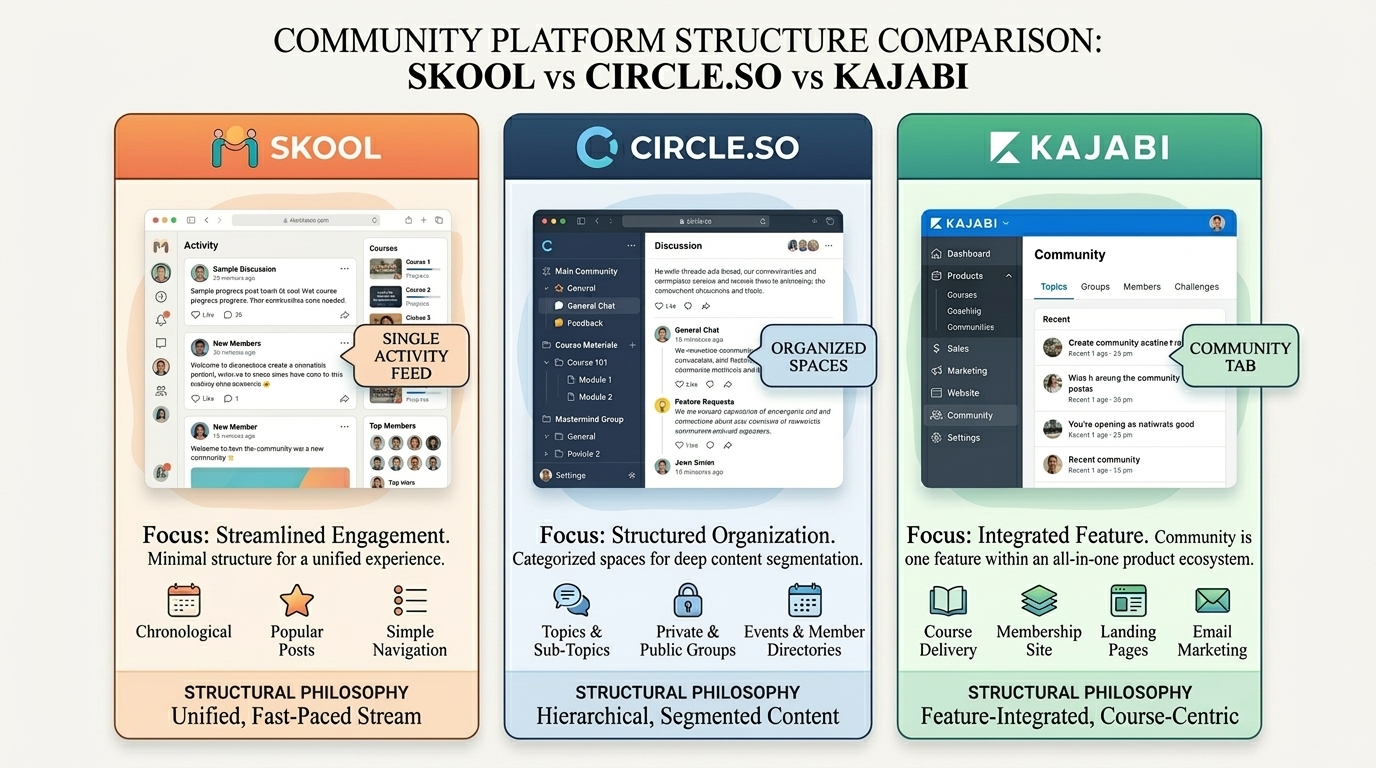
Skool is built around engagement. The core idea is that a community should feel like somewhere people actually want to show up, not a tab they close after posting once.
Circle is a bit different. It focuses around organization and brand control. It’s a community hub that scales with you and carries your name, not theirs. So you get this fully branded community platform with AI assisted management tools.
And then there is Kajabi that is built to replace your entire tool stack: courses, email sequences, funnels, website, and community all under one login. Kajabi is not just a community platform. It’s like having a website, email marketing stack, community, courses and whatever you need. However, in trying to do everything they end up missing out everything.
Kajabi added community because enough users asked for it. Skool and Circle built their platforms around community from day one. You can feel that difference the moment real members are inside in how they engage, how often they return, and how much effort it takes to keep the space alive.
Let me share my personal experience and feedback on each of these tools. Then we will get to side-by-side comparison.
Skool: The Platform That Gets Members to Actually Show Up
In short, Skool gives you a community feed, a course classroom and gamification with points and leaderboards. It adds an events calendar, native live calls, email broadcasts to members and native video hosting. The Skool Hobby plan starts at $9/month with a 10% + 30¢ fee per sale. The Pro plan is $99/month with 2.9% + 30¢, card processing included. That ties Kajabi Basic on Kajabi Payments and costs less than Circle Professional once Stripe’s fee is added.
Skool setup itself takes around 15 minutes as I covered on YouTube.

There’s no complex design work. You post a link, members join, and within a few days the leaderboard already has people competing for engagement.
Skool Gamification is Superior
The engagement rates on Skool communities are different from what you see elsewhere. Gamification creates a daily habit loop. Members earn points for posting, commenting, and completing lessons, then compete on a leaderboard that resets each month. It sounds simple, and that habit loop is the main reason members come back daily.
Also the Skool discovery marketplace is the platform’s most underrated advantage. Communities that pass Skool’s minimum of members, posts and activity are listed in a public directory, ranked by growth, engagement and retention. This means Skool itself sends you members. Circle launched its own Discover directory in 2025, but it is smaller and opt-in, and Kajabi has none. If you’re running a free community as a front-end to a paid offer, this changes your acquisition math entirely.
Price is also a genuine win. Among community platforms with courses and gamification, nothing else starts at $9/month. And the $99/month Pro plan is competitive against anything Circle charges, especially once you factor in transaction fees on top.
btw, you can also join this $1/mo Skool community to experience the platform for almost no price. It is better to experience it as a member before launching one by yourself.
Skool has some limitations
Skool has no email marketing, no sequences, and no funnels. You’ll need a separate tool, something like Kit, to nurture people before they join or follow up with members who go quiet. And I must say, Email marketing should be part of your funnel. It is still the highest ROI marketing.
There’s also no custom domain, which means your community permanently lives at skool.com/yourname. For coaches charging premium prices, that URL signals might matter for your brand.
These gaps matter more to established businesses than to people building their first or second community.
Skool does what it’s built for better than anything else at this price. For a beginner creator, this is the best to begin with.
If community engagement is how you retain members and justify your monthly price, Skool gives you that engine more reliably than any other platform here.
Circle: The Platform for Communities That Need Room to Grow
Circle gives you Spaces and Space Groups. It separates Circle from everything else on this list. Instead of one feed, you get organized rooms for different topics, member segments, courses, and conversations. You also get native live streaming, automation tools, a custom domain, gamification and a well-reviewed mobile app. Email marketing comes through the Email Hub add-on ($99/month), and white-labeling, activity scores and the AI content writer start on the Business plan.
For hosting wellness communities with multiple streams and a multi-dimensional communities, this is what you are looking for.
Circle pricing starts at $89/month billed yearly for Professional and goes to $419/month for Scale, with custom pricing for Circle Plus. Circle takes 2% of sales on Professional, 1% on Business and Scale, and 0.5% on Circle Plus, plus Stripe processing. There is a 14-day free trial.
Circle’s Organization is worth paying for
If you’ve ever watched an active community collapse into an unmanageable scroll of posts, Circle’s Spaces system is the direct solution. You can segment conversations by topic, access level, or membership tier and the structure holds even as things grow.
Also, White-labeling is a business advantage that Skool simply can’t offer. Your community runs on your own domain on every plan, and from Business nothing on the screen says “Circle.” For a high-ticket community it really feels like you are inviting people into your space. I kinda imagine this as an online retreat space.
Members get Circle’s iOS and Android apps on every plan, and Circle Plus adds apps under your own brand.
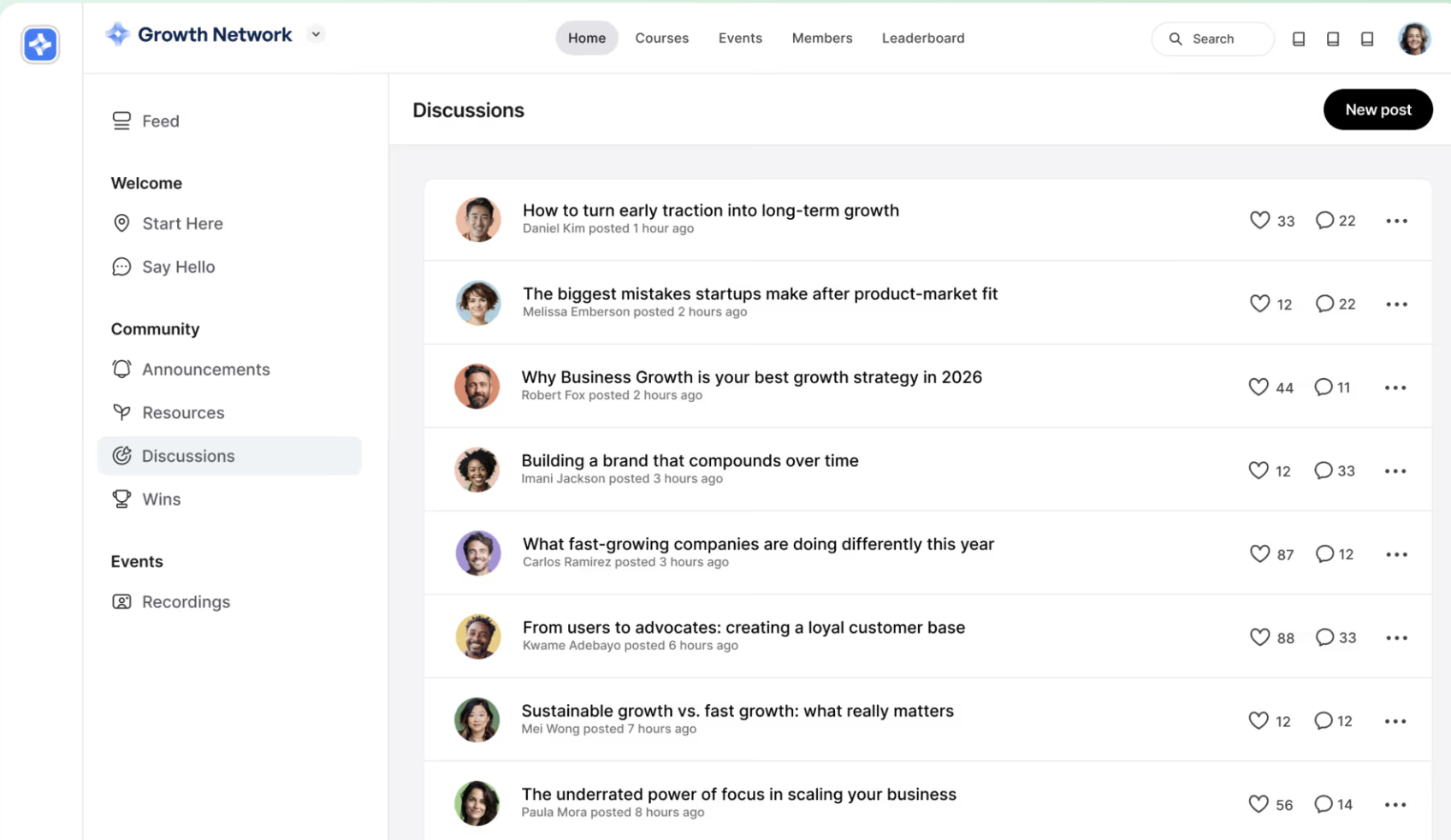
Automation is where Circle separates most clearly from Skool. It connects with Zapier, Make, and custom APIs. And this means onboarding flows, member tagging, and behavioral triggers are all possible without manual intervention. Circle added gamification in July 2024, closing the biggest gap between the two platforms. It’s not identical to Skool’s system yet, but points, leaderboards, and member activity scoring are now part of the experience.
The AI layer is also worth mentioning. Members can use Circle’s built-in AI to summarize recent community activity. Admins get activity scores to spot who’s disengaging before they leave. Skool doesn’t have either of these yet, and this is where Circle is quietly moving ahead.
In my honest experience AI part is more of a problem than solution since it makes me pull away from platforms. While all social media is full of AI stuff, I prefer to go to a niche community to find more human generated content.
However, it really is a choice and having more options is better for many businesses. Circle is definitely superior in terms of features. I would recommend taking a 14-day trial if you are curious.
Circle isn’t perfect for all usecases:
Circle course delivery is basic. It has quizzes now, but no native certificates and only basic student progress tracking. If your courses are a core product rather than a supporting resource, Circle won’t serve them well. The platform is built for community first, and that trade-off shows in the classroom.
Pricing can also surprise you. Transaction fees on top of monthly fees feel manageable until you calculate them at scale. At $10,000/month in membership revenue, even a 2% fee adds $200/month to your bill, on top of the plan price and Stripe’s processing. Run that math at your actual revenue level before committing to an annual plan.
And Circle’s Discover directory is newer, opt-in and smaller than Skool’s, so growth still depends mainly on your own marketing.
Circle in one sentence: Circle is the platform you graduate to when your community needs structure, your brand needs its own identity, and you’ve hit the limits of a single feed.
Read the full Circle breakdown
Kajabi: The All-in-One But with Own Issues
Kajabi includes courses, communities, email marketing with full automation sequences, a funnel builder, landing pages, a CRM, a website builder, podcast hosting, newsletters, and coaching products, all in one platform. Basic costs $179/month billed monthly or $143/month billed yearly. Growth is $249/month ($199 yearly) and Pro is $499/month ($399 yearly).
Kajabi takes no revenue share on Kajabi Payments, where card processing costs 2.9% + 30¢ on Basic and slightly less on Growth and Pro. If you use a third-party payment processor instead, Kajabi adds a 2%, 1% or 0.5% fee depending on the plan.
The community features include Meetups for virtual events, Live Rooms for spontaneous live sessions, and Challenges just like Skool and Circle. The list is real.
Kajabi is solid for a few usecases
If you’re running an actual business with an email list, a course library, and a funnel that converts, Kajabi is the only platform here that handles all of it natively. No separate Mailchimp subscription. No ClickFunnels or WordPress bill. No standalone course platform. It offers one login, one fee, one system that knows your members across every touchpoint.
Kajabi’s Course delivery is the most sophisticated of the three. There are structured modules, drip content, quizzes and assessments, completion certificates and student progress tracking, and it’s a proper LMS, not just a video library behind a paywall.
No revenue share on Kajabi Payments is a real advantage at scale. At $50,000/month in membership revenue, you pay your plan and card processing, with no platform percentage on top. Against Circle Professional, Kajabi Basic costs less once sales pass about $2,700 a month.
If you are not using Kit or any other tool for building email list, behavioral triggers, audience segmentation, and full sales sequences is super useful. Kajabi’s marketing engine is built for people who know how to use it.
But there are three problems with Kajabi as a community platform
The community. Not because it doesn’t work, but because you can feel the difference between a platform built around community and one where community was added later. Kajabi now has points, badges, leaderboards and challenges, but they live inside one community tab within a course platform. Members have less pulling them back the next day.
I have seen Kajabi memberships where people are barely returning to the platform which increases churn rate.
The price. Kajabi raised prices for existing customers from January 13, 2026. Basic went from $149 to $179/month, Growth from $199 to $249, and contact limits on Basic dropped to 2,500. It is a lot for a beginner creator or even an information startup.
The starting point. At $143/month minimum, Kajabi isn’t a starting point for most people. It makes sense once you have revenue and tools to consolidate. For a cheaper Kajabi alternative built around community, cohorts and events, Heartbeat starts at $49 a month.
Kajabi earns its price when you’re paying three separate tool bills and would rather consolidate everything. It is not the right first platform, and the community features are not why anyone chooses it.
Skool vs Circle: head to head
Skool wins on price, daily engagement and discovery, and its Pro plan includes card processing. Circle wins on structure, branding and automation, with Spaces and your own domain on every plan. At $5,000 a month in member revenue, Skool Pro costs about $274 and Circle Professional about $364. Members who pay to talk to each other and build a daily habit fit Skool. Brands that need Spaces, their own domain and workflows fit Circle.
Skool vs Kajabi: head to head
Skool is a community with courses attached. Kajabi is a course and marketing business with a community attached.
- Price: Skool costs $9 or $99 a month. Kajabi starts at $143 a month billed yearly, or $179 monthly.
- Fees: Skool Pro takes 2.9% + 30¢ with processing included. Kajabi Basic on Kajabi Payments costs the same 2.9% + 30¢, with no revenue share.
- Courses: Skool’s classroom is simple: drag-and-drop modules, native video uploads or video from YouTube, Vimeo, Wistia or Loom, files and progress. Kajabi adds assessments, completion certificates, product blueprints and deeper course automation.
- Engagement: Skool’s leaderboard, levels and unlocks keep members active daily. Kajabi’s gamification exists but sits inside one tab.
- Marketing: Kajabi has email sequences, funnels, landing pages and a CRM. Skool has a one-click email broadcast and nothing more.
- Growth: Skool Discovery can send you members. Kajabi has no directory.
- Moving platforms: In my experience helping creators migrate, a move to Skool usually takes a few days because there is less to rebuild. A move to Kajabi takes longer because funnels, emails and pages come with it.
My pick: Skool for a community-led coaching or membership business. Kajabi once you already run courses, email and funnels as separate tools and want them under one login.
Circle vs Kajabi: head to head
Circle and Kajabi both suit established creators, but they solve different problems.
- Price: Circle Professional costs $89 a month billed yearly. Kajabi Basic costs $143 a month billed yearly.
- Fees: Circle takes 2% of sales on Professional plus Stripe processing. Kajabi charges 2.9% + 30¢ on Kajabi Payments with no revenue share, so it costs less than Circle Professional above about $2,700 a month in sales.
- Community: Circle’s Spaces, gamification and Discover directory make the community the product. Kajabi’s community supports its courses.
- Courses: Kajabi has the stronger course builder, with assessments and completion certificates. Circle has quizzes but no native certificates.
- Marketing: Kajabi includes email sequences, funnels and a website. Circle sells email as a $99/month add-on and has no funnel builder.
- Branding: Both run on your own domain. Circle removes its branding from the Business plan and adds branded apps on Circle Plus, while Kajabi includes a branded app on its Pro plan.
My pick: Circle when members pay for the community itself. Kajabi when the community is a bonus inside a course and email business.
What each platform costs at $2K, $5K and $10K a month
These figures assume $50 payments from US cards, yearly billing for Circle and Kajabi, Skool at its monthly price, and each platform’s fee and card processing:
- Skool Pro: $169 / $274 / $449
- Kajabi Basic (Kajabi Payments): $213 / $318 / $493
- Circle Professional: $199 / $364 / $639
- Skool Hobby: $221 / $539 / $1,069
Skool Pro stays cheapest of the three at every level. Kajabi Basic costs $44 more than Skool Pro at every level, because both charge 2.9% + 30¢, and it costs less than Circle Professional once sales pass about $2,700 a month. Skool Hobby only makes sense below about $1,270 a month. Whop, with no monthly fee, comes in lower still at about $165 on $5,000 in sales, the cheapest of the Skool alternatives.
The Side-by-Side Comparison
| Skool | Circle | Kajabi | |
|---|---|---|---|
| Starting price | $9/mo | $89/mo (yearly) | $143/mo (yearly) or $179/mo |
| Transaction fees | 10% + 30¢ (Hobby) or 2.9% + 30¢ (Pro), processing included | 2% to 0.5% plus Stripe | 2.9% + 30¢ on Kajabi Payments, no revenue share; 2% to 0.5% on other processors |
| Member engagement | Highest | Middle | Lowest |
| Community structure | Single feed | Spaces + Groups | Basic tab |
| Email marketing | Broadcast only | Add-on ($99/mo) | Yes |
| Custom domain | No | Yes | Yes |
| Native live streaming | Yes | Yes | Yes |
| Gamification | Pioneer | Yes | Yes (points, badges, leaderboards) |
| Discovery marketplace | Yes | Yes (smaller, opt-in) | No |
| Course delivery | Basic | Basic, with quizzes | Full LMS |
| Setup time | Hours | Days | A week or more |
As you can see above, Skool, Circle and Kajabi all are a little bit different. But the more important thing isn’t on the table: how members feel the first time they log in, and whether they come back the next day without being nudged.
Skool’s much less discussed part is a community called Skoolers, which runs the Skool Games. You learn from the top community builders on Skool and get education that can be duplicated for your own business. None of these platforms offer it. And as a community builder you have access to this for free.
Also, Skool communities have the highest daily active engagement of the three. Circle communities have enough structure that members can actually find what they’re looking for. Kajabi communities are functional but they’re rarely why anyone stays subscribed.
Who Should Actually Use Which One
Skool is the right call if you’re building a community-first business. You want members engaged, not just enrolled. You’re moving out of Facebook Groups, starting your first paid community, or running a coaching program where the group itself is the product. Your budget is lean, and $99/month with 2.9% makes more sense than $400/month for tools you don’t need yet. The discovery marketplace is a real bonus if organic growth is part of your strategy, because an active group can rank in Skool Discovery without paid ads.
Circle is the right call if you’ve outgrown simple. Your community has grown past the point where one feed makes sense. If you want your brand front and center, your domain, your design, no platform watermark. You need automation because you’re not willing to manually manage onboarding for every new member. The transaction fee structure is worth checking at your current revenue level before you commit, but for a growing operation with 200+ members, Circle earns its price.
Kajabi is the right call if you’re consolidating. You have a real business with courses, email sequences, and a live funnel, and you’re currently paying Mailchimp, a course platform, and something else for funnel builder separately. The combined cost already justifies Kajabi’s fee. Go in knowing the price can change, knowing community engagement isn’t the platform’s strength, and knowing the contact limits on the Basic plan are tighter than they look.
My personal opinion on all three platforms
There’s no objectively best platform here. There’s the right one for where you are and what you’re actually trying to build.
For most coaches and creators, especially anyone building their first or second paid community, Skool is the honest answer. It costs the least, members show up the most, and you can be live today. The gaps are real but workable. The things it does well are exactly what early-stage community businesses need.
Circle is where you go when simplicity stops being enough. Structure, branding, automation and scale: Circle handles all of it. It’s not where you start, but it is where serious community businesses tend to end up.
Kajabi makes sense when you’re running a full online business and consolidation is the actual goal. After the January 2026 price increase, it is worth going in with clear expectations. It’s a powerful tool. It’s also one where the terms can change.
The platform doesn’t build your community. You do. Pick the one you’ll actually launch on. If it comes down to Skool or Circle, start with what members pay for: conversation and momentum point to Skool, structure and your own brand point to Circle.
Frequently Asked Questions
Is Skool better than Kajabi for community building?
For engagement, yes. Skool’s gamification drives daily member activity that Kajabi’s community tab doesn’t produce. Kajabi now has points, badges and leaderboards too, but its community was added to a course and marketing platform, while Skool was built around the community.
Is Circle or Kajabi better for a community?
Circle is better when the community is the product: Spaces, gamification, discovery and lower prices below about $2,700 a month in sales. Kajabi is better when the community supports a course and email business, because it adds funnels, email sequences and a full course builder.
Can you replace Kajabi with Circle?
If you use Kajabi mainly for community and course delivery, yes. Circle handles both, and costs less while sales stay below about $2,700 a month. If your business depends on Kajabi’s email sequences, funnel builder or CRM, you would need separate tools, which can offset the savings quickly.
What’s the cheapest community platform for coaches in 2026?
Among community platforms with courses and gamification, Skool’s $9 Hobby plan is the cheapest start (Whop and Systeme.io have no monthly fee but fewer community features), with a 10% + 30¢ fee per sale. Skool Pro costs $99 with 2.9% + 30¢. Circle starts at $89 a month billed yearly plus 2% and Stripe processing. Kajabi starts at $143 a month billed yearly.
Does Circle have better organization than Skool?
Yes. Spaces and Space Groups give Circle a level of structure that Skool’s single feed doesn’t match. For a small, focused community, Skool’s simplicity is an advantage. Once a large group covers courses, events, discussions and support, Circle’s organization is what lets members find their way around.
Which platform has the best free trial?
Skool and Circle both offer 14-day free trials, and Circle needs no credit card. Kajabi has run 14-day trials as limited promotions and offers a 30-day money-back guarantee. Skool’s $9 Hobby plan is also the lowest-cost way to stay live after a trial, and a trial on Skool’s Pro plan shows you every feature.
Is Skool cheaper than Kajabi?
Yes. Kajabi vs Skool on price: Skool costs $9 or $99 a month, and Kajabi starts at $143 billed yearly. Both charge 2.9% + 30¢ per sale on their top payment options, so Kajabi Basic costs about $44 a month more than Skool Pro at any revenue level.
Does Kajabi charge transaction fees?
Kajabi takes no revenue share on Kajabi Payments, where card processing costs 2.9% + 30¢ on Basic and slightly less on higher plans. On a third-party processor, Kajabi adds 2%, 1% or 0.5% depending on the plan. In a Kajabi vs Circle comparison, that makes Kajabi cheaper than Circle Professional above about $2,700 a month in sales.
The Letter
Get the next article in your inbox.
What I am building, as it happens. The community experiments, launches and numbers behind my own work, including what did not work.
The tools, tested before I recommend them. Short notes on the platforms I try for running communities, courses and email, before they become full reviews.
The inner side of the work. Ideas on focus, meaning and energy for creators who want a business that feels as good as it performs.
Get The Letter in your inbox
One short email, usually weekly. You can unsubscribe any time.
Keep reading
More from Community building.