What is Whop? The Platform Behind the Clipping Craze, Explained

Whop is a marketplace and storefront where creators sell digital products: paid communities, courses, Discord access, software, ebooks, and subscriptions. There is no monthly fee. You pay per sale: 2.7% + 30¢ on a domestic card sale, plus 3% only on products gated through Whop’s Discord or Telegram app. Whop’s marketplace, with millions of monthly visitors, can send you customers you did not bring yourself.
But there have been growing number of people accusing Whop to be a scam. I have used and reviewed Whop extensively. If you are wondering what is Whop exactly and can you actually make money with it, you are at the right place.
It is worth knowing whether Whop deserves the attention before you create your own whop community or start a clipping business.
I see many people sharing only good things and ignoring the red flags. But I must warn you, It is not for everyone.
Think of Whop as Shopify for digital products, with a built-in marketplace attached. You set up a storefront, list what you sell, and Whop handles checkout, delivery, access, and payments.
The part that makes it different from a normal checkout tool is the marketplace itself, where buyers already on the platform browse and discover products the way they would on an app store.
I first paid attention to Whop through the clipping economy, where most paid clipping campaigns live, and then watched it quietly become the default home for a much wider range of digital businesses.
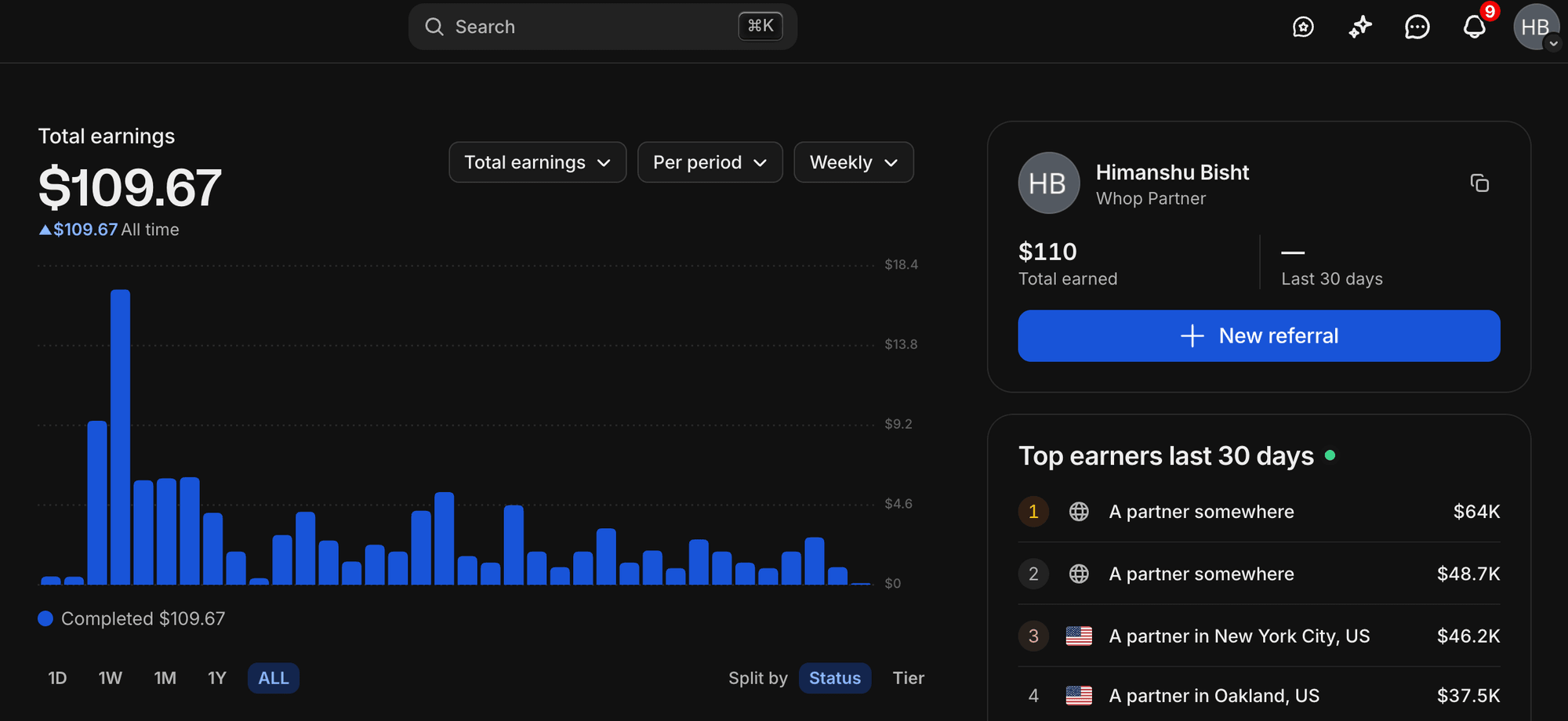
This partner earnings dashboard on Whop shows $109.67 earned. It is a small number, and it is real, which is the point: real accounts look like this, not like the screenshots in hype threads.
What Whop actually is
Whop’s homepage now pitches it as a way to “create or run businesses with AI.” In practice it is three things stacked together.
A storefront. You create a product page, called a whop, where people buy access to whatever you sell. Checkout, payment, delivery, and access management are handled for you.
An access layer. When someone buys, Whop grants them the thing automatically: a role in your Discord, a login to your course, a software license key, a file download, or entry to a community hosted on Whop itself. This is the piece that made it the standard for paid Discord and Telegram groups, because gating access used to require duct-taped bots.
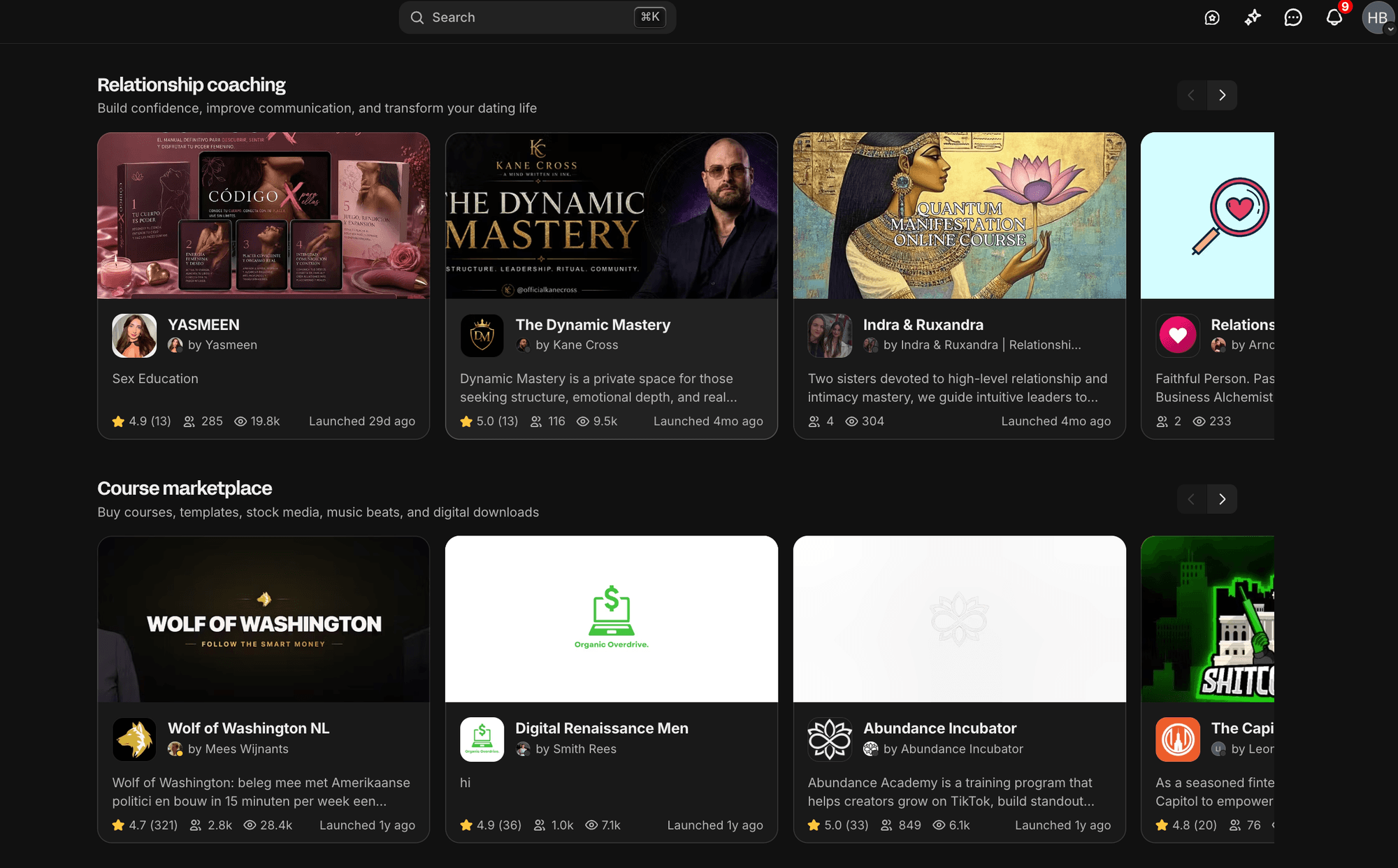
A marketplace. Whop’s discovery surface, called Discover, has more than 4 million monthly visitors according to Sacra. They browse categories like trading, sports picks, ecommerce, AI tools, clipping campaigns and courses. In my experience, products rank by relevance, ratings, sales momentum and category fit. A well-reviewed product can pull customers the creator never marketed to.
Most selling tools are pipes nowadays: they process the demand you generate. Whop is a pipe with a crowd standing next to it. This is why there is a big young audience using Whop to monetize their audience.
What you can sell on Whop
The range is wider than most people assume. The main categories:
- Paid communities, hosted on Whop directly or gated on Discord and Telegram
- Courses and coaching, with native course hosting
- Software and SaaS licenses, including key distribution
- Digital downloads: ebooks, templates, presets, indicators
- Memberships and subscriptions of almost any shape
- Clipping campaigns, where brands and creators fund bounties and clippers get paid per verified view
That last category deserves a note, because it is how a lot of people first meet the platform. Whop became the main venue where creators post clipping bounties and clippers submit work, which turned it into a two-sided labor market on top of the product marketplace.
How does Whop work? Selling step by step
The setup takes an evening, not a week. Here is the actual sequence.
1. Create your whop.
Sign up, name your product, and pick its type: community, course, digital download, software, or a bundle. This creates the product page buyers will see.
2. Connect what you are gating.
For a Discord community, you authorize Whop’s bot and choose which roles paying members receive. For a course, you upload lessons into the native course builder. For downloads and license keys, you attach the files or key pool. Access management, the part that used to require custom bots, happens automatically from here.
3. Set pricing.
One-time, recurring, or tiered. You can run a free tier next to paid ones, which works well as a funnel: free members see the paid layer from inside.
4. Write the listing like a landing page.
Your title and first lines are what marketplace browsers see. Lead with the outcome, show proof, and be specific about what is inside, because vague listings get clicks and refunds rather than members who stay.
5. Choose your category and go live.
Category placement decides which browsers find you, the same way it does on any app store. Pick the narrowest accurate one.
6. Drive your first sales yourself.
Marketplace ranking leans on ratings and sales momentum, so your first buyers set the flywheel spinning. Launch to your audience, however small, collect honest reviews, and let the marketplace take over from a warm start rather than a cold one.
Is Whop clipping legit? How Content Rewards pays
Whop clipping is legit: brands fund real budgets, and Whop pays approved clips automatically. But approval sits with the campaign owner, so a clip can get real views and still earn nothing.
Clipping campaigns on Whop work like bounty boards. A creator or brand funds a campaign, sets a rate per thousand verified views, defines the rules, which platforms, what content, what counts as a valid view, and clippers enroll, post clips, and submit their results. Whop tracks submissions and handles the payouts.
For clippers, it is the largest single venue for finding paid campaigns, and the fine print matters more than the rate: verification rules, minimum thresholds, and payout timing decide what you actually receive.
Campaign rates on Whop commonly run $1 to $4 per 1,000 views. Three things on the campaign page decide whether a clip pays: the rules for an approved clip, the minimum payout and how much budget is left. A campaign with half its budget gone can close before your clip is reviewed. Vyro and Clipping.net run similar per-view campaigns, but Whop has the most clipping campaigns that pay live at any given time.
For creators and brands, it is infrastructure that would otherwise take a spreadsheet and a lot of trust: funding, tracking, and paying dozens of clippers without building anything.
The reason this matters beyond clipping: it shows what Whop actually is at its core, a payments and access layer that can host almost any arrangement between a creator and the people they work with, whether those people are customers, members, or contractors.
What Whop costs
There is no monthly fee, no setup cost, and no minimum. You pay when you sell.
The structure, in plain terms: payment processing costs 2.7% + 30¢ per domestic card sale, with 1.5% more for international cards. Products gated through Whop’s Discord or Telegram app pay another 3%. On a $100 domestic card sale of a course or download you keep $97.00, and on a $100 Discord membership you keep $94.00, before payout fees. Whop’s payout fees are charged per withdrawal, not per sale: next-day ACH to a US bank costs $2.50, and each dispute costs $15.
The marketplace fee is gone: Whop’s fee page lists no separate fee for Discover sales. Whop has since dropped its 30% Discover commission to 0%, according to Sacra, so sales that come through discovery now cost the same as sales you drive yourself.
For comparison, Gumroad charges a flat 10% plus 50 cents on direct sales and 30% on its own Discover sales, and Discord’s native server subscriptions (available to US-based owners only) take 10%. Whop sits meaningfully below both, which matters more as your volume grows.
How the marketplace ranks products
Whop does not publish its ranking rules. From what I have seen, Whop surfaces products based on relevance to the search or category, ratings, sales momentum, and how active the attached community is. Good reviews compound: products that satisfy buyers rank higher, which brings more buyers, which brings more reviews. It behaves like an app store algorithm rather than a social feed, which means slow, durable climbing beats viral spikes.
Practical consequence: your rating is your ranking. Refund cleanly, deliver what the page promises, and keep the community active, because a 4.9 with steady sales will outrank a bigger product with churn and complaints.
Practical moves before you launch
A few decisions made before launch determine most of what happens after, so make them deliberately.
Run a free tier as a funnel.
A free access level next to your paid one lets marketplace browsers step inside before paying, and buyers who have seen the room convert at a completely different rate than buyers reading a sales page. The free tier also grows your member count, which is its own social proof on the listing.
Price for the review, not just the sale.
Early on, your rating is worth more than your margin, because ratings drive marketplace ranking and ranking drives everything after. A slightly underpriced first hundred customers who feel they got a bargain will build the review base that lets you charge properly later.
Ask for the review at the peak.
The best moment is right after a member gets a win, not at some automated interval. A simple personal message at that moment outperforms any sequence.
Capture emails from day one.
Whatever buyer details Whop shows you, your own email list is the asset that survives any platform decision, yours or theirs. Route buyers into your own email flow immediately, thank-you page, welcome message, wherever fits.
Watch your refund reasons.
Refunds are inevitable and mostly harmless, but the reasons cluster, and the cluster is free product research. If three people say the same thing on the way out, the listing overpromised or the product underdelivered in the same specific spot, and fixing it lifts both retention and rating.
Who Whop is for, and who it is not for
It suits you if you sell access to something recurring: a community, picks or signals, coaching, software, or a course with a membership attached. It also suits you if you have no audience yet, because the marketplace gives you a discovery channel that a plain checkout page never will.
It is a weaker fit if you sell one high-ticket item to a warm audience you already own, where a simple payment link does the job without a platform around it. And if your brand demands a fully white-label experience on your own domain, a marketplace listing may feel off-brand compared to something like Circle or your own site.
The honest middle: many creators run both, their own site for the brand and Whop for the marketplace demand and the access management.
How Whop compares to the obvious alternatives like Gumroad
Whop is not the only community platform attempting to monetize attention. There are some other similar tools like Skool, Circle and Nas.io for example.
If I think of Gumroad for comparison, Whop is cheaper per sale and adds community gating, while Gumroad remains simpler for pure file downloads and handles global sales tax as merchant of record.
Other tools like Stan Store that offer link-in-bio checkouts can be better for simple use of putting link on Instagram. However, Whop is heavier but far more capable once you sell recurring access rather than one-off products. And discovery is a massive plus.
Against Skool or Circle or Kajabi, the comparison is really community-platform versus commerce-platform. Skool is a better place for the community itself to live. Whop is certainly a better cash register and discovery engine, and plenty of owners gate a Discord with Whop instead of moving anywhere.
Whop’s per-sale economics beat almost everything except a flat-fee tool at high volume, and nothing else pairs low fees with an active discovery surface.
The honest downsides of Whop
The marketplace has a reputation gradient.
Whop grew up around trading signals, sports picks, and reselling communities, categories with a real scam history. The platform polices harder than it used to and the mix has broadened enormously, but if your brand is, say, executive coaching, check how your category looks before assuming the marketplace context helps you.
Community features are functional, not deep.
Whop-hosted communities cover chat, content, and events, but they are thinner than Skool’s structured feed or Circle’s spaces. Most serious communities on Whop actually live on Discord with Whop as the gate, which works well but means running two tools.
Discovery is earned slowly.
The marketplace rewards ratings and sales momentum, which means it compounds for established products and does little for brand-new ones. Expect your first months of sales to come from your own effort, with the marketplace as a growing tailwind rather than a launch engine.
You are building on a platform.
Your storefront, reviews, and ranking live on Whop’s infrastructure. That is true of every marketplace, and the standard advice applies: collect emails, own the relationship, and treat the platform as a channel rather than the business itself.
Commonly Asked Whop Questions and Verified Answers
What is Whop used for?
Whop is used to sell access to digital products: paid communities, Discord and Telegram groups, courses, software licenses, ebooks and subscriptions. Creators use it as a storefront and checkout, and buyers use its marketplace to discover products.
Is Whop free to use?
There is no monthly fee. Whop charges 2.7% + 30¢ per domestic card sale, and products gated through its Discord or Telegram app pay another 3%. You only pay when you sell.
How does Whop make money?
Through fees on each sale and each payout, plus optional services such as tax collection (2%). Whop’s fee page lists no separate marketplace fee, so sales from Whop’s Discover marketplace cost the same as direct sales.
Is Whop clipping legit?
Yes. Brands fund real campaign budgets on Whop’s Content Rewards, and Whop pays approved clips automatically based on their views. Only approved clips are paid, so the campaign’s rules, minimum payout and remaining budget decide what you actually earn.
How much do Whop clipping campaigns pay?
Each campaign sets its own rate per 1,000 views. Rates commonly run $1 to $4, and Whop’s own example uses $3 per 1,000 views. Some campaigns add a flat fee per approved clip and cap how much one video can earn.
Is Whop legit and safe?
Yes. Whop is a venture-backed company that processes payments itself, handles access automatically and says it has paid more than $4.6 billion to businesses. Individual products vary in quality, so a seller’s track record is worth checking before you buy.
Whop vs Gumroad: which is better?
Whop charges 2.7% + 30¢ per domestic card sale (plus 3% on Discord or Telegram-gated products) against Gumroad’s 10% + 50¢ on direct sales, and Whop’s marketplace sales carry no extra fee, against Gumroad’s 30% on Discover sales. Gumroad stays simpler for one-off file downloads and handles sales tax as merchant of record.
Can you make money on Whop without an audience?
It is one of the few platforms where that is realistic, because the marketplace sends buyers to well-rated products. Growth without an audience is slower and depends on reviews and category competition, but the discovery channel exists, which a standalone checkout page cannot offer.
Does Whop work for courses?
Yes. Whop hosts courses natively, gates access on payment, and can bundle a course with a community or Discord. It is lighter than a dedicated course platform like Kajabi, which matters mainly if you need advanced funnels and email automation around the course.
Where to go from here
So, what is Whop? A storefront, an access layer, and a marketplace in one, priced by transaction instead of subscription, and currently the busiest discovery surface for paid digital products. If you sell recurring access to anything, it belongs on your shortlist.
Whether it deserves to win that shortlist depends on your product, your margins and how much the marketplace can realistically send you. The weak spots are the thin community features and a marketplace that does little for brand-new products, so plan your first sales without it.
The Letter
Get the next article in your inbox.
What I am building, as it happens. The community experiments, launches and numbers behind my own work, including what did not work.
The tools, tested before I recommend them. Short notes on the platforms I try for running communities, courses and email, before they become full reviews.
The inner side of the work. Ideas on focus, meaning and energy for creators who want a business that feels as good as it performs.
Get The Letter in your inbox
One short email, usually weekly. You can unsubscribe any time.
Keep reading
More from Monetization.