Borderline Controversial Systeme.io Review after 3 Months

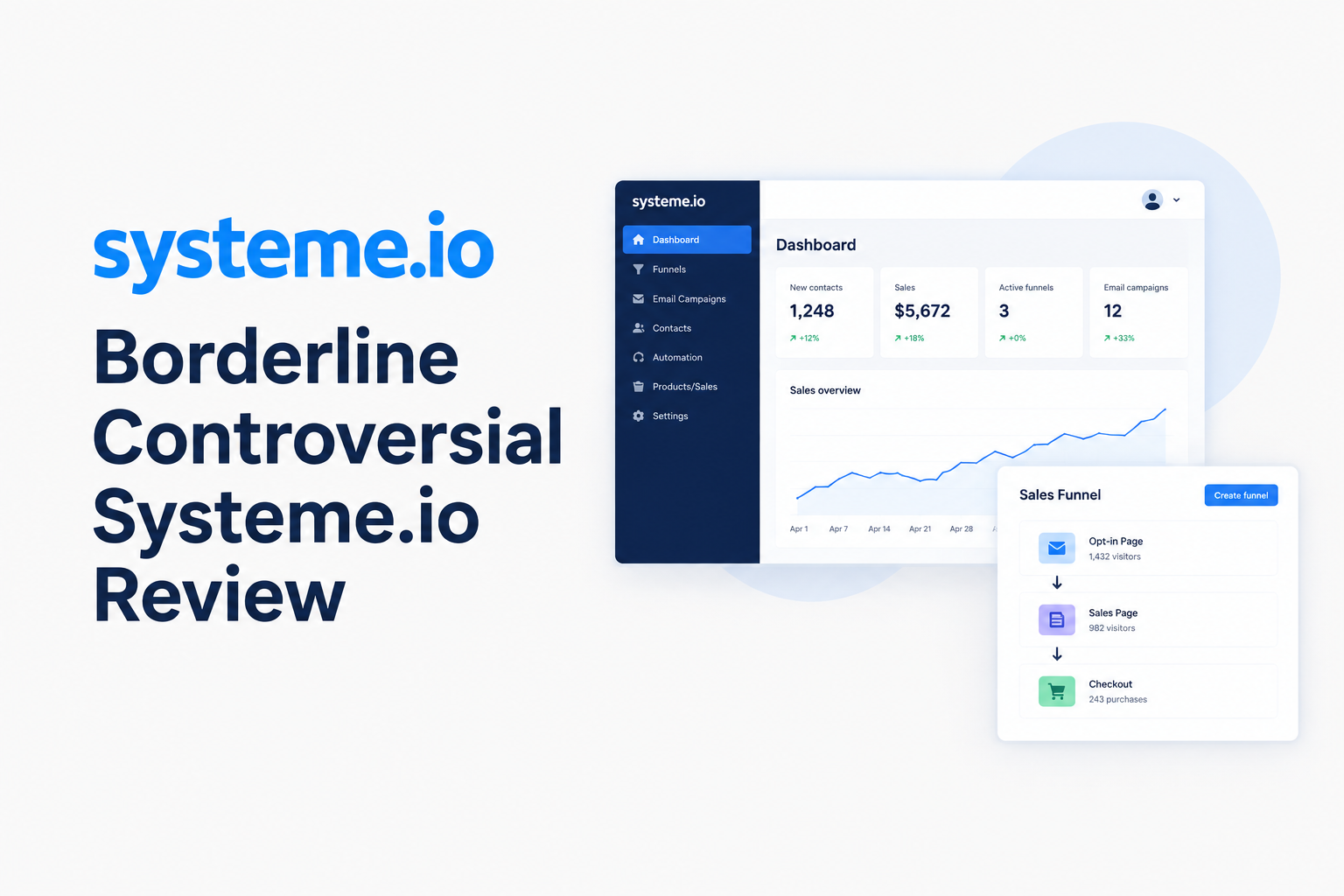
Systeme.io is one of the cheapest ways to run an online business from a single login. Funnels, email, courses, a community and an affiliate program all live in one account.
Aurelien Amacker built Systeme.io in 2018, after eight years of selling his own courses on a patchwork of separate tools. Systeme says more than 500,000 entrepreneurs now use it.
But is “free and all-in-one” really legit? Or is it a marketing gimmick for a below-average tool, just another funnel builder like ClickFunnels?
I tested Systeme.io on the free plan and have spoken with people who run their businesses on it.
I also build communities and have reviewed the course and community platforms Systeme competes with, like Skool and Circle.
Is Systeme.io worth it? Quick verdict (7.5/10)
Yes, for: new coaches, course creators and info-product sellers who want funnels, email, courses and checkout on one bill. It suits people who care more about launching than about design polish.
No, if: you need pixel-level page design, a branded mobile app, a gamified community, or deep native integrations with your existing tools.
Real cost: $0 to start, then $17, $47 or $97 a month. Systeme takes 0% of your sales, though Stripe or PayPal still charge their normal processing fees.
What Systeme.io is, and who it’s built for
Systeme.io replaces the five or six subscriptions a small online business usually stacks up. One login covers:
- landing pages and sales funnels
- a checkout with order bumps and upsells
- email broadcasts and automations
- a course area and a community
- a blog and a booking calendar
- an affiliate program for your own products
The design philosophy comes straight from the founder’s frustration. Amacker argues that more features make a tool harder to use, so Systeme ships what most sellers need and leaves out the rest.
For someone launching a first offer, that restraint is an advantage. Experienced marketers sometimes read the same restraint as thinness.
The ideal user sells knowledge:
- a coach with a lead magnet and a $497 program
- a course creator with a small catalogue
- a consultant who wants bookings and follow-up emails in one place
A business doing complex ecommerce, heavy segmentation or brand-led design sits outside that profile, even though Systeme technically supports physical products.
Systeme.io pricing is a bit strange
Systeme prices its plans by contacts, but funnels, tags and automation rules usually force the upgrade first. The four public plans are:
- Free: $0, up to 2,000 contacts.
- Startup: $17 a month, up to 5,000 contacts.
- Webinar: $47 a month, up to 10,000 contacts, plus evergreen webinars.
- Unlimited: $97 a month, unlimited contacts and every cap removed.
Annual billing gives you two months free. That works out to $170, $470 and $970 a year. A custom “For Teams” tier adds a dedicated success manager.
The limits that move between plans:
- Startup: 10 funnels, 10 automation rules, 5 workflows, 10 tags, 5 courses with unlimited students, and 5 communities.
- Webinar: 50 funnels, 100 automation rules, 20 workflows, 100 tags, 20 courses and up to 10 evergreen webinars.
- Unlimited: removes every cap. It is also the only plan that includes a one-on-one kickstart coaching session, and the only monthly plan with free migration.
Email sends, file storage, community members, sub-accounts and assistant accounts stay unlimited on every plan, Free included. Most standalone email tools charge by list size and send volume, so that alone replaces a meaningful bill.
What “0% transaction fees” actually means
Systeme.io takes no percentage of your sales on any plan. Your payment processor still charges its own fee, though.
Systeme connects to Stripe, PayPal, Apple Pay, Razorpay, Flutterwave, Mercado Pago and Xendit. Each processor bills you directly. Stripe’s standard US card rate is 2.9% + 30¢, so a $97 course sale leaves you about $93.89.
The 0% fee is a clear advantage over platforms that take a cut on top of processing. Skool’s $9 plan, for example, keeps 10% + 30¢ of every sale, with card processing included. Against that plan, Systeme’s $17 Startup plan plus Stripe’s fee costs less once your monthly sales pass about $113.
ClickFunnels and Kajabi don’t take a platform percentage either. Against them, the comparison comes down to subscription price.
The free plan’s real limits
The free plan never expires, needs no credit card, and opens almost every feature. The catch sits in the quantities. The 2,000-contact cap is rarely the first limit you reach.
On Free, you get:
- 1 automation rule and 1 workflow
- 1 email campaign (Systeme’s name for a sequence) and 1 tag
- 3 funnels with 15 steps between them
- 1 course, capped at 500 students
- 1 community, 1 website and 1 blog
- 1 custom domain
- 1 order bump, 1 one-click upsell and 1 A/B test
The tag limit bites first. Systeme sorts contacts with tags, so one tag leaves almost no room to separate a second audience or a second lead magnet.
A single automation rule means a single trigger. One form submission can start your welcome sequence, but a purchase or a second opt-in needs another rule.
In practice, Free fits one clear setup: one lead magnet, one email sequence and one funnel into one paid offer. Plenty of first products launch exactly that way, which is why the free plan is useful rather than a gimmick.
Adding a second audience usually breaks the one-tag setup. At that point, $17 a month raises every limit a small business is likely to hit.
Sales funnels and checkout
Systeme was built around funnels, which remain its strongest feature. You pick a template, edit it in a drag-and-drop builder, and connect pages into a sequence. A typical sequence runs opt-in, thank-you, sales page, checkout, upsell, confirmation.
The checkout covers what most info-product sellers need:
- order bumps
- one-click upsells and downsells
- coupon codes
- A/B tests on pages
- deadline funnels that close an offer after a set time per visitor
Subscriptions and payment plans run through your connected processor.
Building across three separate tools means wiring forms, lists and payments together by hand. In Systeme, the pages, email follow-up and checkout already share one contact record. A first funnel goes live far faster as a result.
Design range is the weakness. The editor works in sections and columns. Its templates look clean but familiar. Brands that depend on distinctive typography, animation or layout reach the editor’s limits fast.
People who need that control often move to WordPress with a funnel theme, a trade-off I cover in ClickFunnels vs WordPress. For a coach whose buyers care about the offer rather than the page styling, the template look rarely matters.
Email marketing and automation
Every funnel needs follow-up after the opt-in. Systeme’s email tools cover more of that job than the price suggests. You can send one-off newsletters, build campaigns and set automation rules on every plan.
Rules respond to triggers such as a form submission, a purchase, a new tag or a completed course. Workflows add branching, delays and decisions on top. Together they handle the welcome, nurture and post-purchase sequences a small course business typically runs.
Systeme’s own help center warns that switching from another email provider resets your sender reputation. New sending infrastructure means inbox providers treat you as a new sender.
Open rates can dip for a while, even with the same domain and list. Warming up by sending to your most engaged subscribers first reduces the drop. Systeme’s deliverability guide lists the rest of its recommended practices.
If your list is still small, the free plan’s single sequence covers the early months. My guide to building an email list from scratch walks through that first stage.
SMS through Twilio
Systeme can send text messages inside the same workflows through your own Twilio account. You add an SMS step after a purchase or tag, personalise it with the contact’s name, and track delivery reports.
Twilio bills you for each message, so only the connection is included in your plan. For coaches running live calls or appointments, a text reminder alongside the email one tends to lift attendance.
Online courses: more complete than they look
Once email brings a buyer in, the course area has to deliver. Systeme’s version is plain on the surface but covers the essentials.
You build courses from modules and lectures, host video directly on Systeme with no storage limit, and drip lessons on a schedule. Quizzes grade automatically, and courses can be bundled and sold as a package.
Completion certificates are native. Systeme generates one automatically once a student marks every lecture complete, with your logo and signature on it. Skool, for comparison, doesn’t offer certificates at all.
Presentation and mobile access are the gaps. Course pages look plain next to a premium LMS, and students use the mobile browser rather than an app. A brand-led course business with a large catalogue will feel both. A coach selling one focused program often won’t.
Systeme.io communities: can they replace Skool or Circle?
Courses and communities increasingly sell together, which is why Systeme includes a community on every plan. It works well as a companion to a course. It struggles as a community business in its own right.
What it covers:
- members can post, comment, upload files, record voice memos, and embed videos from YouTube, Vimeo, Loom and Wistia
- admins organise posts into topics, pin and schedule posts, and moderate before or after publishing
- communities can be private or public, on your own domain
- access sells through your funnels, as a one-time payment or a monthly subscription
Every plan includes at least one community with unlimited members. That makes it a cheap home for a course’s discussion space.
What it lacks is the machinery that brings members back without the owner pushing them:
- no points, levels or leaderboards
- no discovery network that sends new members your way
- no branded mobile app (Systeme’s own comparison page marks this “No”)
From running communities myself, the pattern is consistent. Engagement in a paid group depends on habits. Those habits form around phone notifications and visible progress. Without either, activity tends to concentrate around the owner and a handful of regulars.
Skool is built around exactly those mechanics, with levels, leaderboards and a discovery network. Some creators split the job: Systeme runs their funnels, email and checkout, while Skool hosts the community. My Skool review covers that platform and its fees in detail.
Circle sits at the other end, with deep branding and gamification from $89 a month, plus optional branded apps. My Circle.so review explains where that extra spend pays off.
On any platform, the design of the group decides whether members stay. I break that down in how to build a community people actually want to join.
Webinars, booking, creator store and physical products
Beyond funnels, email, courses and the community, Systeme adds several smaller tools. In a small business, each one can replace a separate subscription.
Evergreen webinars come with the $47 Webinar plan. They are pre-recorded presentations that run on a schedule: hourly, daily, or instantly on registration. Reminder emails, unique access links, timed “buy now” buttons and a replay page are built in.
Live webinars aren’t included, so a live session still needs Zoom or a similar tool. My note on why Zoom can’t run evergreen webinars explains why the two formats need different software.
The booking calendar handles 1 appointment type on Free, 5 on Startup and 20 on Webinar. Bookings are unlimited on every plan. The calendar syncs with Google Calendar, Google Meet and Zoom, which covers a coach selling calls.
The creator store is a link-in-bio page that sells directly. It holds courses, digital downloads, physical products, coaching and even external affiliate links, with email capture built in. Creators whose traffic starts in an Instagram or TikTok bio get the most from it.
Physical products come with shipping, inventory and variant management. Every plan also includes a blog. Both are serviceable extras rather than reasons to choose the platform.
Systeme.io Affiliate management for your own products
Every Systeme plan lets you run an affiliate program for your own offers. Partners get their own links and dashboard. Commissions track through your funnels automatically, with the rate set per product.
For a course creator without an ad budget, partners with an audience are one of the more practical ways to reach new buyers. Recruiting and paying them well is its own skill, which I cover in selling online courses with affiliates.
Sub-accounts and white label: features for consultants and agencies
Sub-accounts and white label turn Systeme from a solo tool into something a consultant or small agency can run client work on.
Sub-accounts are unlimited on every plan. Each one is a full, separate Systeme account with the same limits as your main plan, at no extra cost. On the Unlimited plan, one subscription can therefore power fully independent accounts for several clients or brands.
White label lets you rebrand Systeme with your own name, logo, domain and sender email. You then resell it on plans you define, in multiple currencies, and keep the revenue.
Two conditions apply. Your prices can’t go below Systeme’s own. The plans you can resell also depend on the plan you’re on.
Integrations: the weakest part of the platform
Systeme’s simplicity costs the most when your business depends on outside tools. Native integrations cover the payment processors above, plus:
- Google Sheets, Google Calendar and Google Meet
- Zoom
- ActiveCampaign and SendGrid
- Twilio
Beyond that, you rely on Zapier, webhooks or Systeme’s public API. The API is rate-limited by plan: 30 requests a minute on Free, 60 on Startup, 120 on Webinar and no cap on Unlimited.
Zapier adds another subscription. Webhooks need some technical comfort. If your business depends on a specific CRM, analytics stack or community platform, testing that connection before migrating saves a painful rebuild later.
Support, migration and reputation
Systeme’s strongest reputation sits with its support team. On Trustpilot, it holds a 4.9 rating from more than 8,500 reviews, 94% of them five-star.
Response speed earns most of the praise. Systeme’s pricing page puts its average reply time at under two hours, seven days a week. The most common complaint concerns the learning curve on complex automations.
Free migration comes with the Unlimited plan and with any annual plan. Systeme’s team rebuilds your funnels, pages, email sequences, courses, contacts and affiliate setup, and helps connect your domain. Payment history stays with your original processor.
Leaving takes a little planning. After you cancel, you keep your plan until the next billing date, and then the account drops to the free plan, per the Systeme pricing page. If your list is above 2,000 contacts by then, Systeme’s help center gives you a few days to clean it or upgrade. After that, opt-ins and payments stop working until the account fits the free limits. Exporting your contacts before you cancel avoids that problem.
Systeme.io vs ClickFunnels, Kajabi and Skool
On price alone, Systeme undercuts all three of its usual rivals, yet each rival still wins a specific kind of creator.
Against ClickFunnels, Systeme wins for most creators.
ClickFunnels’ entry Launch plan costs $97 a month, or $81 billed annually, for 10,000 contacts. Systeme’s Webinar plan gives the same contact count for $47, and its free plan covers a first funnel. ClickFunnels offers more design freedom and a larger marketing ecosystem, but few coaches need them at double the price. ClickFunnels’ One Funnel Away Challenge now comes with its 14-day trial, so you can test that ecosystem before paying.
Against Kajabi, the trade is polish versus cost.
Kajabi’s Basic plan costs $179 a month, or $143 annually, for 2,500 contacts. A branded app in the app stores only comes on its $399 Pro plan. Kajabi looks more premium and suits a course brand with revenue behind it. Systeme covers most of the same jobs for a fraction of the price.
Skool, on the other side, is a community platform with courses attached. It charges $9 a month plus 10% + 30¢ per sale, or $99 plus 2.9% + 30¢, with card processing included. Systeme is a sales and marketing platform with a community attached, so the two often work together.
Kartra, GoHighLevel and Kit are the other names that come up when creators compare. Kartra and GoHighLevel compete on funnels and automation at higher prices. Kit is primarily an email tool rather than an all-in-one platform.
My Skool vs Circle vs Kajabi breakdown goes deeper on the community-led side of this decision.
Systeme.io pros and cons
Who should use Systeme.io, and who should skip it
Systeme.io fits you if:
- you are launching your first or second digital product
- you sell coaching, courses or memberships to an audience you’re still building
- you want one bill and one contact record
- you run client work that needs sub-accounts or white label
Look elsewhere if:
- your brand depends on distinctive page design
- your community is the product and engagement drives retention
- your stack depends on native integrations Systeme doesn’t have
- you need live webinars inside the platform
If the community is your main business, my Skool alternatives guide compares the platforms built for that job.
My verdict: 7.5/10
Systeme.io is the best-value all-in-one platform for creators selling knowledge while they build their first offers. The free plan launches a real offer, with one funnel, one sequence and one course. Startup lifts nearly every cap for $17 a month.
Design range, integration depth and community engagement tools cost it points. Those gaps rarely hurt a new coach. They start to hurt once the brand, the community or the tech stack becomes the business.
Where each plan fits:
- Launching your first offer: start on the free plan.
- Running more than one offer or audience: Startup at $17 a month.
- Selling through evergreen webinars: the Webinar plan.
- When design or community becomes the product: a specialist tool.
You can open a free account at systeme.io without a credit card.
FAQ
Is Systeme.io really free?
Yes. The free plan never expires and needs no credit card. It includes 2,000 contacts, 3 funnels, 1 course with up to 500 students, 1 community and unlimited email sends. The tighter limits are 1 automation rule, 1 email campaign and 1 tag, which restrict you to one lead magnet and one sequence.
Does Systeme.io take a transaction fee?
No. Systeme.io charges 0% on sales on every plan, including Free. Your payment processor still takes its own fee. With Stripe’s standard US rate of 2.9% + 30¢, a $97 sale leaves you about $93.89. Systeme confirms the 0% fee on its pricing page.
Is Systeme.io legit?
Yes. Systeme.io has operated since 2018 and says it has more than 500,000 users. It holds a 4.9 rating from over 8,500 Trustpilot reviews, with fast support as the most common praise. You can also test the whole platform on the free plan before paying anything.
Can Systeme.io replace ClickFunnels?
For most coaches and course creators, yes. Systeme covers funnels, order bumps, upsells, email and courses at a lower price, with 10,000 contacts for $47 a month against ClickFunnels’ $97. ClickFunnels still offers more design freedom. If distinctive page design drives your conversions, that gap may justify the higher price.
Can you build a paid community on Systeme.io?
Yes. Every plan includes at least one community with unlimited members. You can sell access as a one-time payment or monthly subscription through your funnels. It suits a course’s discussion space. It lacks leaderboards, gamification and a branded mobile app, so a community-first business usually fits better on a dedicated platform.
Does Systeme.io have a mobile app?
No. Systeme.io doesn’t offer a branded mobile app for your students or community members, and its own comparison page lists this as a gap. Members open your course and community pages in a mobile browser instead. Creators who need an app-store presence usually look at Kajabi’s Pro plan or Circle’s branded apps.
What happens to my contacts if I cancel Systeme.io?
Cancelling drops your account to the free plan at the next billing date rather than closing it. If you have more than 2,000 contacts, Systeme gives you a few days to clean your list or upgrade. After that, opt-ins and payments stop working until the account fits the free limits, so exporting your contacts first is a sensible step.
Is Systeme.io good for beginners?
Yes, it is one of the easiest all-in-one platforms to start on. The free plan removes cost pressure, while the editor uses templates rather than code. Support usually replies within hours. The learning curve shows up later, with complex automations and workflows.
The Letter
Get the next article in your inbox.
What I am building, as it happens. The community experiments, launches and numbers behind my own work, including what did not work.
The tools, tested before I recommend them. Short notes on the platforms I try for running communities, courses and email, before they become full reviews.
The inner side of the work. Ideas on focus, meaning and energy for creators who want a business that feels as good as it performs.
Get The Letter in your inbox
One short email, usually weekly. You can unsubscribe any time.